anzeigen
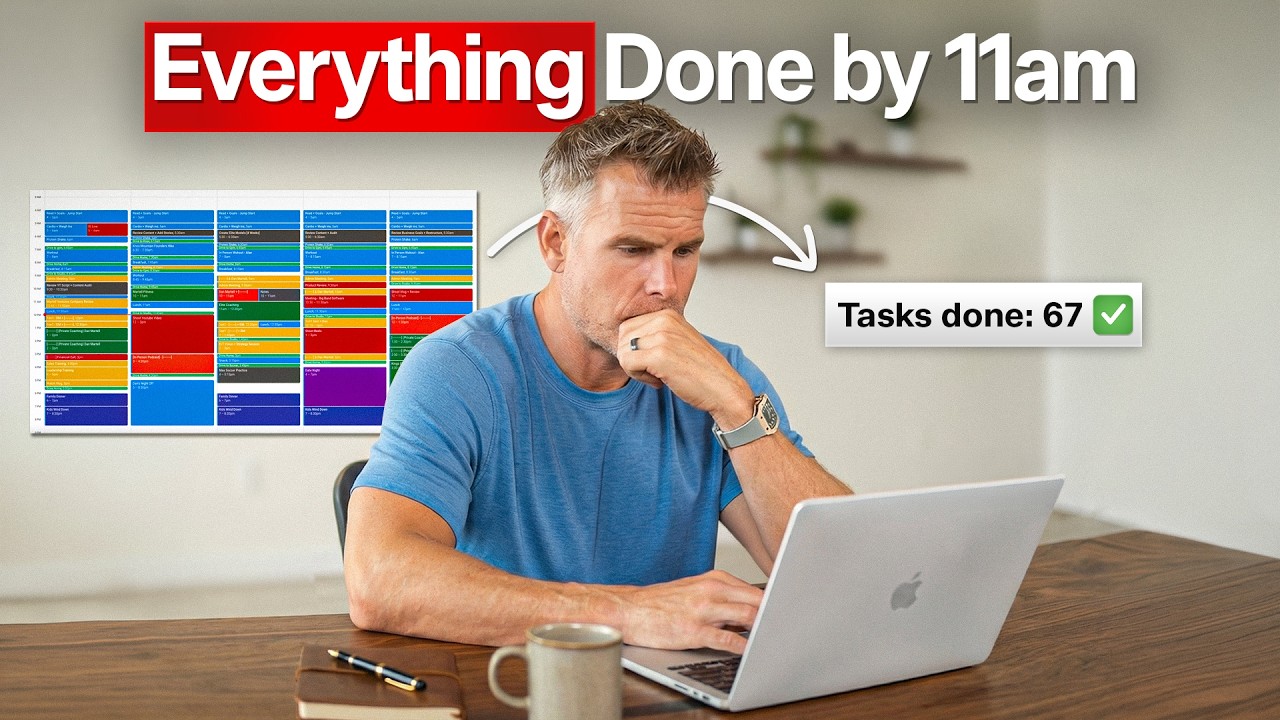
You're procrastinating way too freaking much. You know it and I know it. So today, we're going to fix that. And look, it's not because you're lazy. It's not because you don't care. It's because procrastination isn't what you think it is. It's actually two separate problems happening at the same time, and nobody teaches you how to solve either. I get it. I have pretty hardcore ADHD, which makes it pretty impossible for me to do anything without getting distracted. But despite all of that, I've been able to build a nine-figure empire and help thousands of other entrepreneurs do the exact same. And I can tell you, you don't just beat procrastination with brute force. There are ways to hack your brain into being 10 times more productive, if not more. So in this video, I'm going to show you why you keep getting distracted, how to eliminate those distractions, how to stay locked in when you're actually doing the work, and how to permanently wire these systems into your brain so they run on autopilot. Starting with point number one, why you actually procrastinate in the first place. See, most people think distractions come from the outside. I'm talking emails and the pinging and the phone buzzing and Slack notifications going off, but that's not true. The real problem is internal triggers. My friend Nir Eyal, an author of Indistractable, says that we reach for distractions to escape boredom, loneliness, fear, fatigue, uncertainty. We use these distractions that might make you think you're productive, but you're actually using them to keep yourself busy doing stuff that doesn't do anything. People avoid things that might stress them out. I remember Jeff Bezos said, he says, "Stress primarily comes from not taking action over something that you can [music] have some control over." So the stress that you created by not doing the thing is where the stress came from versus just saying, "I got control over this. Let me do something with it." So now that you understand the reasons behind distractions, we need to move forward. We need to figure out what all those distractions actually [music] are so you can attack them. Which takes us to the next point. Point number two, signal versus noise. Steve Jobs used to talk about this idea of focusing on what really matters, which is signal versus what really doesn't, which is the noise. Signal in many ways follows the Pareto principle, which is 20% of the work actually drives 80% of the results. The noise is everything else, and it falls into two categories. The busy work, keeping you busy but doesn't actually do anything, or the distraction, the vices, the video games, the talking with your friends for hours, reading the news, watching the sports games. These are all things that just keep you distracted from actually getting the work done. I remember I was running my first company, I was busy, working 100-hour weeks, and then I hired a coach, and my coach analyzed my calendar. And when he looked at it, he said, "Hey, did you know you spend 70% of your time in meetings that are just like getting updates, and honestly, you're not producing any results? Sales, which drives revenue, was only 10% of my calendar." See, he could see the signal in all the noise, and I was pretending not to see it, but the truth was is that I was just allowing myself to be distracted because it felt productive. That's why I always go back to a simple premise. If you show me your calendar and your bank account, I will show you what's important to you. So, here's what I want you to do right now. Go grab something to write with. It can be a blank piece of paper, or pull out your phone and start a new note, but find something to write with. Number one, draw two columns. Just put a direct line down the middle of that page, one labeled signal, the other one labeled noise. The second thing is I want you to think about everything that you did in the last couple weeks, and I want you to write it down on that piece of paper in those two columns. It's either noise or it's signal. So, what you'll probably notice is you'll have a lot of stuff in the noise column. And what you want to do is get most of your week to be in the signal column. I know a lot of business owners that are trying to scale past seven figures, and they're stuck in the noise. They can't find their way out. That's why I created my scale your business workbook. It teaches you how to buy back your time and get out of the noise. And if you want my step-by-step process, just find me on Instagram and message me the word scale YouTube, and I'll send it right over to you. So, now you know what you're spending your time on when it comes to single to noise. You can see exactly where you're wasting time, and you can probably diagnose some of the stuff in the noise column that you need to cut to get rid of. So, how do you actually do that? Point number three, eliminating distractions. The way we become more productive is first, we have to make it difficult for you to get distracted, and we have to break out the habits of defaulting to devices. So, here are two ways you can do this. I call it the friction rule. Either we add friction to make it hard, or we remove friction to make it work. So, the first thing is we got to procrastinate the distraction itself. If you're about to go open up Instagram and go doom scroll, I want you to at least make a commitment to yourself. And I know it sounds weird cuz you're like, "Well, I was about to do it. How am I going to not do it?" I'm telling you just give yourself 10 minutes. I'll actually allow you to do it. If you can go, "Hey, I'm going to wait 10 minutes until I go and I doom scroll on Instagram cuz I really want to right now." But, you put it off, I guarantee you're probably not going to want to do it. And the truth is, you'll usually get back into momentum, and you won't even want the distraction anymore. You just got to create separation from impulse to reaction. If that doesn't work, let's add some friction. Let's make it hard on yourself. It's kind of like this fun game where I think about it's easier to avoid the dragon than to slay it. See, most people are like, "I'm going to have food in my house." And I'm like, "Well, then you're going to want to eat that crap food." Versus if you take the food and you put it out of the house, then you got to get in your car to go buy the food you shouldn't eat. That made it hard. See how that creates friction? I like to make it easy for me to make good decisions. So, I want to go to the gym in the morning, so I prep all my clothes so that when I wake up, it's sitting there. My shoes, my clothes. I pretty much told everybody, including my wife, "I'm going to the gym in the morning." So, there's no way I'm not going to do it because everybody would see it. Everybody would know. You have to make it easy to make the right choices. So, the cool part is is now you've made it nearly impossible for you to get distracted, or at least added some friction. But, here's where most people still get stuck. They sit down to work and nothing happens because they're waiting for a spark of inspiration, something that might never come to them. Which brings us to point number four, building momentum. This is not what you think it is. See, first gear is usually easy to get into. Second gear is easier because you're already in first gear and then third gear is easier cuz now you're in second gear and you have momentum. The higher you go, the smoother the shifts. Let me explain. When you're driving a car and you got to put it into gear, there's actually a lot of mechanical friction to do that, right? The first gear is always the hardest. Then you get going, the engine revs up, second gear, smoother, keep going, the higher you go, the smoother the shifts. By the time you're in third, fourth is way easier. If you go from zero to fourth, it doesn't work. And then once you're going, fourth to fifth, you'll barely notice because you're already in momentum. And as a guy that literally drives his cars every day doing donuts, I know the power of mechanical momentum. And most people will wait until they're motivated, inspired, and feeling good about their situation before they even start and shift into first. You don't need motivation. You don't need inspiration. You don't need to feel it. I say often times, just feel the feeling, supply the plane. What you need is to start. And if you have the privilege of starting and being in momentum, and you know when you're in it, stay in it. Fight to be in it. I think too many people give up their power of momentum to anybody that's willing to distract them. They sell their dreams for cheap cheap prices because they'd rather be distracted than to be consistent. If you're staring at a blank page, do anything. If you're staring at yourself in the mirror, you don't like what you see, go for a walk. You can start a diet halfway through a bag of chips and then you can build momentum. You can decide to start the business by calling anybody and ask them to buy something. That first sale means you're now in business. Momentum is the key. The thing that stops people from winning in general is they don't have clarity around what they want to do. So, step one, write down just the steps of doing what you know you've been avoiding, even if you don't make a commitment to doing it. Try that. Then, step two, pick anything that is a small task that you could do that takes less than 2 minutes. That's called the MINS, most important next step. Then, if that felt good, do another one. And then do another one. And just start and build momentum and go from first gear to second gear to third gear. See, once you have clarity and you know what you could be doing and you take action and you get some results, then you feel good and you start to build and that is how we create and stay momentum. So, often times, I won't even make a commitment to doing the project, I'll just be like, I'll make a commitment to making a list of things I know that I got to do if I started the project. Then once I got the list, I'm like, "Ooh, okay, maybe I can do one of those." And then I do [music] it. And then I say, "No, I'm like, I'll do another one cuz that felt good." And I do another one. And then I'm like, "Ooh, I'm getting some feedback. It's feeling good. I can see where the finish line's going to come from." And then I'm just like, "Oh my gosh, I can't believe I thought I had to be motivated to even start." So, now we got momentum, you're in motion. But we got to make sure that you're not just staying busy, we actually have to be efficient in what we're doing, which takes us to point number five, doing the work efficiently. That's where I use Parkinson's law, which states the work expands to fill the time you give it. I can't tell you how often people say to me, "Hey man, I'll get that to you by the end of the week." And I go, "Why not Wednesday?" "Well, I could do it Wednesday." "All right, by when?" "End of the day." "Why not noon?" "Yeah, I could probably do it by noon." "Cool. What changed from the first time I asked for it to get done and me asking if you can get it done sooner?" They're like, "I don't know." It's like, "How about we do that to ourselves?" So, I'm a big fan of saying what is aggressive but not impossible. Because if you don't, you will just take up as much time as you want to get the task done. It's like when I go on vacation, the day before I leave, I get everything that are open loops done. Why? Because I know the next day I'm gone for a while. So, think about what's the mindset you had before you went on vacation. How do you live your day that way? See, if there's no date, there's no priority, there's no pressure, there's no execution. So, what I've done is I've built a system on how to do that, and it comes in three parts. Here's how we go about it step by step. One, we want to allocate specific amounts of time to finish the task [music] and schedule in the calendar. I'm talking a day of the week, a date in the calendar, and a time of day. This is called time blocking. And the reason I do this is that the more you do it, the more you'll learn to estimate properly. Most people are always late because they don't ever give themselves deadlines, so they don't know if they overestimated or underestimated. The second thing is at the end of that time, schedule a meeting with somebody else, or make a commitment to show somebody the work that you did during that time block. That'll create a forcing function for you to get it done because you know right after you're in another meeting, or you promised to show somebody the work you've done so far. It basically creates a deadline you have to stick to. And then the third step is once I've committed to that time block, I like to break it into 25 minute chunks, which are called Pomodoros. And then I have a timer that literally sits on my computer, and it runs off every 25 minutes, and I got to focus on whatever I wrote down I would get done in that 25 minutes, and I get it done. This system creates a massive amounts of productivity and accountability because it gives you an efficient way to force you to focus, to force you to stay in momentum, to force you to get the thing done. So, now that we've eliminated all the distraction, we've built momentum, and we've learned how to work efficiently, here's the next thing. If you stop here, you're going to have to keep fighting yourself every single day, forcing yourself to focus. It's going to feel hard. It's going to feel exhausting. So, the last step is to make it easy and permanent. Point number six, turning hacks into identity. I remember one time I was talking to Tony Robbins, and he said, "The strongest force in human personality is the need to stay consistent with how we've defined ourselves. The stories we tell ourselves is our identity. It's our ego. And us being consistent on how we see ourselves is crazy powerful." So, the last step is to turn those habits into identity so you never have to think about them again. So, for example, if I asked you how many times did you have to stop yourself from buying a vape when you're driving home after work if you don't vape? Probably never. Why? Cuz you don't vape. You have an identity of that's not who I am. And eventually, a habit like going to the gym becomes an identity, I'm an athlete, and athletes go to the gym, and athletes don't order pizza for lunch, and athletes are very consistent in their training, and athletes have coaches. All of a sudden, that identity drives your behaviors. And we want to do that for your productivity. When it becomes part of your identity, you don't have to hack yourself anymore. I have an identity that I'm the kind of person that preps before meeting, that gets done on time, that follows my calendar 100%, so I don't have to sit there and stress myself out trying to do these things because it's who I am. So, here's what I want you to do. First off, we're going to write one sentence, I always. And I want you to finish this with identity statements that essentially is empowering. If you think about the person who easily achieves the results that you do in your life, what do they always do? Do they always work efficiently? They always put stuff in their calendar? They always break things down easier? They always meet their deadlines? Write that down. And the second sentence is I never. And finish this with something that you no longer want to do, or something you know that's holding you back. Maybe it's a vice. I never eat after 6:00 p.m. I never play video games. I never watch sports. I don't know what it is for you. I know I just said some crazy stuff, but ask yourself, if I had to give up some short-term distractions for long-term dreams, what would those be? And write down I never and insert that there. What I always tell people is you have a 10.0 version of yourself that you could become. And I think that person already exists. You just got to start acting like that person today. So, the key is is to repeat those statements all the time until your brain believes it, until it becomes identity, until it becomes just who you are. So, now you've got everything that I believe in avoiding the distractions to staying focused and building momentum. You just need to make a simple commitment. Just start. What work have you been avoiding? Where is the potential for your next breakthrough? Just write it below in the comments. I'm going to read them all and I want to know that you got what I was sharing. And remember, if you haven't already, find me on Instagram, Dan Martell, two L's in Martell, and DM me the word scale YouTube and I'll send you over my full scale your business workbook. And if you want to learn how to make 2026 your best year ever, click here and I'll see you on the other side.