anzeigen
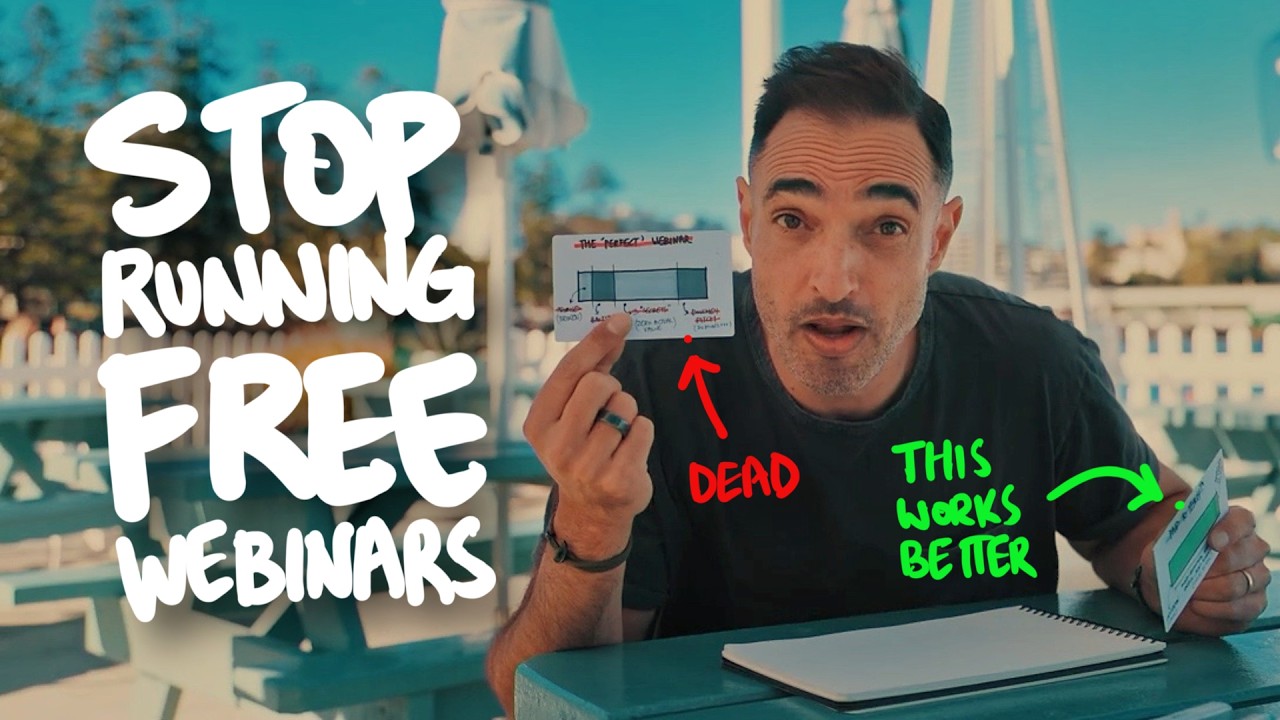
Free webinars attract broke tire kickers. I mean, think about it. The people you want as clients are probably already a little bit successful. Successful usually means busy. Busy means they don't want to sit through another 90-minute waste of time, zero value pitch fest. So, when we switched from free webinar to paid workshop, couple things happened. Firstly, the number of qualified people who showed up went from 5% to 55% instantly. And secondly, we got paid twice. Once when they bought a ticket, and second, when they became a client. In fact, now we're doing $100,000 a month just in ticket sales. Plus all the clients on the back end. So, in this video, I want to show you why free webinars suck and paid workshops are better. Most importantly, how to build one and how to fill one so you can sign up some clients yourself this month. So, I don't know if you know this, dude, but uh this workshop webinar piece is actually part four in a series on the marketing map. It's like a little behind the scenes on how we're getting leads and signing clients. What's working for us right now to get us to 1.7, 1.8 million dollars a month. And it's the same map that we use with our clients. If you missed the intro or the others in the series, uh it's probably in a playlist somewhere. Look down, look up, look around. Just be alert and you'll find it. So, today we're going to zoom in to the workshop. We run it once a month, and it's a core part of our strategy for taking cold people and getting them to become a client. Let's get started. So, here's the problem. Every month for 10 years, maybe 11, I ran a free webinar. And we get hundreds, maybe thousands of people to register for this thing. Thousand people register, a bunch of them show up, not as many as I'd like, but that's okay. But when we looked at the data about who registered and who showed, only 5% of the people who showed up were the people we really wanted. We did it for years because I'm not a slow learner. I'm a thorough learner. Sometimes it takes me a long time to figure out that the thing I've been doing is dumb. 5% were qualified, which meant that 95% of the people who showed up were broke tire kickers. Nothing wrong with them. They're just looking for free information cuz they've got lots of time and no money, and free information is what those guys live on. There's nothing more frustrating than putting a great presentation, spending a bunch of time and effort and frankly money marketing to get people to show up, only to find out that most of the people who showed up to your party aren't the people you really wanted to invite in the first place. It's a waste of time. Maybe you're doing something good for the community, but frankly, I'd like some clients. So, finally exasperated, I decided to do something a bit different. We wanted to switch from free webinar to paid workshop. It sounds like not much different. There's really two significant changes. Obviously, free to paid. We charge 100 bucks, but the idea is the same. It wants to be an impulse buy for the right people, but like expensive enough that the tire kickers stay away. Here's what happened. The very first time we did it, just by making that one change from free to paid, the number of people who showed up who were actually qualified went from 5% to 55% instantly. And we hadn't even delivered the workshop yet. Which brings me to the second big change. Free to paid and webinar to workshop. Everybody knows what a webinar is. They're kind of lame. But a workshop is different. Firstly, in my head, and secondly, for the audience. A workshop delivers an actual promise. It delivers a result. You can't just flap your lips. You've got to deliver something useful. And so, the thing that changed in my head was man, all these people are coming and they're paying money. I mean, it's not much money each, but they've invested some cash. And And there's a bunch of them. So, it's on me to deliver something absolutely killer. Just like I treated them like clients. So, the sessions were better. I showed up different, and the people who came were different. So, what happened? Well, the very first time we did it, we ended up making $30,000 in ticket sales and signing 15 or 20 back dollars at the end without even having to make a heavy pitch, which I'll explain to you in a moment. This month, we do $100,000 a month in ticket sales, plus back builder sold out now 12 months in a row just because this workshop happens once a month like clockwork. I'm going to show you how to do it. So, now we know that free webinars are done, and paid workshops are great. To show you what goes in it, I'm going to compare the two models. The perfect webinar and the paid to teach paid workshop model. So, gray, when I'm talking about this, I'm talking about the old way, probably what not to do, certainly what I don't do. And when I'm showing you this green one in a moment, I'll show you what to do instead. So, the first thing you're going to is you're going to start charging some money. I don't care what the price is. I've got clients who do $7 or $27 or $50 or $200. $100 great for me for a business coach audience that's a little bit more sophisticated, it's perfect. But, let's talk about the delivery, what you actually do. And I want to showcase the difference between two different approaches. So, let's talk about what to put in the thing so it's actually worth the money and it still sells. I want to show you the traditional way. It's called the perfect webinar script. It was built by a guy called Russell Brunson who's a certified genius and has helped a bunch of us. If what I'm about to say sounds a little bit like I'm shitcanning the perfect webinar formula, it's cuz I am. There's nothing wrong with it unless you want to deliver actual real value to people and get handsomely paid. I think it worked great back in 2018, maybe 2022. Uh my market's more sophisticated and frankly I can't live with myself delivering no value. Uh let me give you the formula. I'm going to exaggerate the shitness of it. I think Russell Brunson is a genius. I wanted to say those two things can both be true at the same time. Here is the structure of the perfect webinar. Each of these chunks is one of the four key pieces. At start, we make some promises. Usually, we break them. Second, we've got a whole chunk reserved for your tragic backstory. You know how you started off living homeless under a bridge sucking dicks to make a dollar, living in your car, having to perform sexual favors. Right at the lowest point. Probably, your version will be slightly different, but you get the idea. I'm exaggerating here. Then at the lowest point, you discovered this this thing and it changed everything for you. And then you started sharing it with clients. And now, you're here on this webinar to release the secrets to the audience. Backstory, tragic. Then we let your audience in on three secrets. They're not actually useful or practical or how-to. They're good for building belief and confidence that your solution is the right solution. It's a low proof, a lot of NLP mind not a lot of actual useful stuff. It's got its place, but not in one of my workshops. Then, by the time we've done this, we've primed, we've made some promises that we're going to break, we've told them about our tragic backstory and released three secrets. Now, it's time for a very long douchy pitch. That's step number four. This is the formula online marketers have been running for ages. And I'm obviously unashamedly at full dramatic effect. I never felt comfortable doing that cuz I just didn't think it was actually useful. And if someone's going to spend time with me, or in the new model, time and money with me, I want them to get an immediate return on investment. I've said this twice already, but just in case anyone gets the wrong idea, Russell Brunson, you're a G. There's no need to send the Boise Mafia after me. That's the structure that the online marketers and the coaches have been playing for years. I think it's kind of lame. So, instead, I'm going to show you how you get paid to teach. The structure is very different. I'm going to give you the very high-level overview just so you can dramatically see the differences. We don't need a dramatic 30-minute, you know, steak knives pitch at the end. Instead, we make the invitation twice. Once at the very start for about 2 minutes, and once again at the end for maybe 3 or 4 minutes, and we walk people through the offer. And all we do at the start is like, "Okay, so we're about to cover this sort of stuff. I'm opening up a few spots in my program, I'd say, in Black Belt. If you want to find out the details, just comment the word BB below, and I'll send you the link you can check it out." And so, once the people have typed BB, and we just drop them the link, and even before we before we started teaching, people have started buying, which is kind of fun. The truth is that everybody's got this secret fear when they're on a workshop like this. Oh, is this going to be one of those lame pitch fest where you teach me some secrets and then try to pitch me on this expensive product? Let's just get that out right at the beginning. There is a program. It's called Black Belt. It's available. If you want to find out the details, there's a zero pressure, but if you comment the word BB, the letters BB in the Zoom chat below, I'll give you the link. And people do, and they get the link, and they can read it on their own time and buy. And about a quarter of our sales happen before we've even got to the end where the normal pitch usually starts. So, that's the opening 2 minutes. Then we have 1 hour and 56 minutes, longer if it's me cuz I can't shut the hell up, of mind-blowing, result-getting, useful, fun workshop goodness. We pick a micro topic, and we actually get them a real result. Now, the risk is if you teach too much, maybe people will feel satiated and not need to buy. I I we tackle that two ways. Firstly, pick a micro topic. Not everything cuz you don't have time, but if we pick one small problem and we solve it live and at the start we go, "Hey, so this is These are all the problems you've got. Today we're going to solve that one." What have we just done? We've shown them the hole, we zoom into a part, and we solve that, and at the end we go, "Hey, by the way, we've just solved this problem. Remember the hole? You've still got holes in the hole. And if you want some help, comment the word BB below and I'll show you how we do that." And then we just walk people through the offer doc and they go buy. The big difference here visually is pretty obvious. There's 2 minutes of pitch at the start. There's two or three minutes of how the details work at the end if people want to go deeper with you, and the rest is actually useful. There's some seating that goes on. I'm not going to I'm not going to pretend there isn't, but mostly my job is delivering an outcome. So, about three or four months ago I was working with this cat called Tristan. Uh he's a client I've been working with for 13 years. When we first started working together, he joined us on a Tuesday and ran his first free webinar with you know, my old model, which I guess was closer to that thing, and did $336,000 in sales on his second day in the program and paid off his mortgage in cash. So, he's no slouch to the webinar model. But times have changed and people aren't responding to the old stuff like they like they used to. So, about 3 and 1/2 months ago, I helped him with his first ever paid workshop. Uh registration numbers were a little bit lower because it was paid, but the quality was sky high. His very first attempt at paid workshop and selling without a call, 10 people read the offer doc and bought. It was $2,000 a month. He was over the moon. But cuz he's got clients all around the world, he was doing another one the next morning for the other side of the planet. And he signed up another six. In his first two goes, first 4 hours doing this, I suppose, he signed 16 clients, $32,000 a month in extra cash. And guess what? The last 3 and 1/2 months, he's done it twice a month every time. The same model. He's absolutely killing it. I mean, he's a great coach, but what really makes this work is in the old model we've got two groups of people. We've got leads, you know, people who are new to you, and clients, people paying you a bunch of money, but there's nothing in the middle. A paid workshop gives you a third group. You've got leads, customers, and clients. And the person most likely to become a client is somebody who's already spent a little bit of money and a little bit of time with you. That's why it works. So, with that said, let me walk you through the six steps to building a campaign that actually gets people to register and show up and buy your program. So, there are six steps to do this. You can skip steps. I'm just going to give you the whole thing cuz I'm feeling kind of generous today. Uh I'll give you the overview. There's other videos on the on the channel about how to how to do this in detail, but let me give you the um the highlight reel right now. Step one is called setup. The most important thing in this whole campaign is that you pick a topic that is hot and attractive. It's got to be one, something that solves a real pressing problem for people, a bleeding neck issue. And number two, something that you've got some energy about yourself. Ideally, some great results for you, maybe great results for clients, but certainly something that you're a bit fired up about. The hook and the title really matters because then we can build the page. And now we've got something ready to promote. Step two, sign up. We're going to get people to register for this thing. For us, it looks like a one-week campaign. So, our workshops are on Tuesdays. That's not important, it just fits in my calendar nicely. And we promote from Tuesday to Tuesday, 7 days to fill this thing up. So, the two most important things in setup are the hook or the title. Like, what's the promise of this workshop? I usually find that by going, "What's working great in my business or with clients? Or have I got some content that's absolutely blowing up right now? Can I use that topic? Full transparency, often they're the same thing. Next up comes sign up. This is the first time where your audience actually hears about the topic. For us, it's a one-week campaign. It's Tuesday to Tuesday, but whatever workshop day you're doing, go back 7 days, that's when it starts. And there are three core components. We've got some emails which go out uh using our campaign cadence. We'll talk about that in a future video. Problem, proof, philosophy, plan. A hand raiser at the start. Doors closing at the end. That's that's a week. Those get mirrored onto short-form videos, reels. And usually there's a carousel. In terms of the ads, we just boost the Instagram reels which are doing well. More people see them, more people comment the word, more people find out about the workshop, buy ticket and off we go. Here's what's super interesting. If you start the campaign and it's not going that great, do not stop or cancel the workshop. Our graph for registrations looks like this. If this is the first day we start promoting it, you know, 7 days out, 6 5 4 3 2 1 0. The graph looks like this. Here we get a little bit at the start. You know, some every day and then in the last 24 hours ka-ching bingo bongo bonanza. Literally 50% of the sales workshop tickets get bought at the end. Just like 50% of the population buys good their Christmas presents on Christmas Eve. That's right, dads, I'm looking at you. Hey, no judgment. That's what I do. Remember what we're fighting against here is a big list of people who register who are never going to buy anything. We just want the buyers and that's what we got. Step three, show up. In the normal free webinar model, getting people to show up is really hard. You know, you might get 20 or 30% of the people to show up live. If you're brand new and your audience is smaller, maybe that's higher, but over time that's going to drop. We don't frankly do anything that clever for the show up campaign except charge money in the first place because when people pay, they pay attention. Step four, this is where the fun's at. This is when they're live on the workshop with you. You got two jobs. The first one, I tried to make it end in up. It doesn't really work. Blow up. We want to blow their minds. We want to blow their minds with actual real value. If we do a good job here, not only are we teaching a solution, but we're teaching people what to want. Here's everything you need. We're going to zoom into this one. Da da da da da. And remember, you need all these pieces. We make a little invitation at the start, little invitation at the end, but our main job here is we actually deliver epic value and we blow people's minds. Other people come to 14 workshops in a row. So, I must be doing something right or something wrong cuz they haven't joined the program yet. You be the judge. Step five, pay up. This is where we get them to join your program. This is where we make the invitation. Uh Uh, you're like me, you're selling sales list with a doc. And so at the start and the end of the workshop, I'll let people know if they're interested they can comment a word, they do, and they read the doc and they buy. If you're like half of our clients and you still sell with sales calls, no shame at all. Then we just get people to do the same, but we put the the invitations at the start and at the end, just like I said before. If you really need volume of sales calls and the quality isn't quite as important, you can bundle in the call as part of the workshop ticket and then part of the show up campaign and the start of the workshop is, "Hey, you you bought this workshop. There's going to do today. Your step one, two, three we're going to do here live. Step four and five we do an old custom one-on-one conversation. Click here now to book your call and we'll do those last two steps together." That works great. That's a little boardroom source I got from Adam and Pete who've been doing that with school principals and it's crushing for them and other clients use it as well. I don't do sales calls, so that's not my model. But if you do, that's killer. Otherwise, we do the start of the workshop uh, the why piece, getting people like thirsty for what you got and then we say, "Hey, and if you want some help with this, we're going to go really fast, but if you want some help implementing this, I've asked my team to put aside some 10 or 15 minute consults to help you with a game plan. Click here and book it right now." And we do that at the start and at the end and it works great. As we go through this series, there's going to be a couple of things that I'm going to teach you that I don't do. Not cuz I'm a hypocrite, just cuz I used to do them and I changed my business model, so we don't have sales people. So anything that involves like chat or calls or appointments or talking to people one-on-one, we don't do that. So I'll tell you what works for our clients, but I don't want to say I still do it. So right now things are looking really good. Set up, sign up, show up, blow up, pay up. The last two kind of happen at the same time. I'm much better at this now. But my first two or maybe three paid workshops, I blew people's minds, but I didn't make that many sales live on the workshop and I was worried that I was doing it wrong. Obviously, there's some stuff to tweak, but we still made a huge amount of sales just because of the follow-up, last step. All I'm saying is, if you do all this and you make some ticket sales, but you don't sign clients, all is not lost, my friend, because follow-up will get you probably half your clients anyway. Let me sketch you out the follow-up campaign. It's really straightforward. At the end of your workshop, you've really got four groups of people. We've got people who bought, awesome, we love them. Well, welcome aboard new clients. And of everyone who's left, we split them into three buckets. We've got people who um bought a ticket and showed up, but didn't buy. Uh we've got people who bought a ticket and couldn't make it live. And we've got the stupid ones who never bought a ticket in the first place. So, let's build a simple follow-up campaign over 3 days for each of those groups. Our campaigns for showed up and bought but didn't show are actually pretty similar. I don't want to make this too difficult. So, I'm just going to give you a high-level overview. For people who showed up but didn't buy, uh the first email comes out straight afterwards going, "Hey, it was great having you on. Uh the recording will be up soon. I'll let you know when it's here. I would love to know what was your highlight?" And that gives us a ton of like value and social proof that we can use in future marketing. Plus, it makes me feel great. So, this is the what you loved. Then we send out the replay. And the replay is "Hey, we move really fast. There's lots of great stuff there. If you need it, the replay is now live. PS, there's X number of spots left and X amount of hours to go to grab it." Then we do a highlight from the workshop. One of the things that people really love was this moment here. It's at minute 15 and 32 seconds of the video. Uh you can click and watch it right now. PS, there's now only X spots left and X much time. And then we do a final doors closing uh train's leaving the station, get on board right now. For the people who bought but didn't show, the campaign is almost identical. Obviously, we can't say what people loved. But after we've got a bunch of responses, if we want to, we can still say, "Here's what other people loved." Then we do the same. Here's the recording. Uh PS, we've opened this thing up. There's X X amount of spots left for X amount of days. Click here and grab it. For the top guys, we're driving to the offer and using the other stuff as a reason to email. For the people who bought but didn't show, we're driving to the replay with a PS of and join the thing. And the campaign is identical. And for non-buyers, we sell the workshop recordings uh for the same $100 for 72 hours. Invariably, whether it's the deadline to join the program or the deadline to get the recording, people always leave it too late and go, "Oh, I just missed it." And literally, they reply to me with an email with with the email which says, "Hey, doors are closing in 2 hours." Like, 3 weeks later. 3 weeks later. "Hey, is there still any spots?" I'm not sure. I'm like, of course you're freaking sure. You just read below that it's been sold out. It was 2 hours 2 hours to go 3 weeks ago. "Can I get it?" Nope. Hold your boundaries. So, for the non-buyers, it's the same sort of campaign, but we're selling the replay. Usually, for these guys, we don't open up spots because by the time we get to thinking about these guys, all of the spots in Blackbelt are gone cuz we sell out every month. So, let's talk about what you got and what to do next. Here's what you got. Free webinars suck. They're dead. The old system, that thing, kind of lame. Do this instead, and you'll do heaps better. It's the 2026 2027 friendly version. So, what do you do next? I said at the start, this is part of a series. If you missed one, you can go back and either watch the overview or click on the video that's most useful for you in the playlist. But if you just want to know what's next, we're going to jump into the nurture cycle, talk about how to micro-web your prospects that you record once and it works for you forever, warming people from warm to hot without you even showing up. That's right here on the next video.