

Same tool everyone else uses. Different order, different result. Move one, rank your segments by business value before …
0,9×Faktor (Views / Median 6.566, n=35)
5.827Views
74Likes
8Kommentare
Analyse-Fehler: 400 {"type":"error","error":{"type":"invalid_request_error","message":"Your credit balance is too low to access the Anthropic API. Please go to Plans & Billing to upgrade or purchase credits."},"request_id":"req_011CesTCqSUdEXvYaJRjrBGt"}
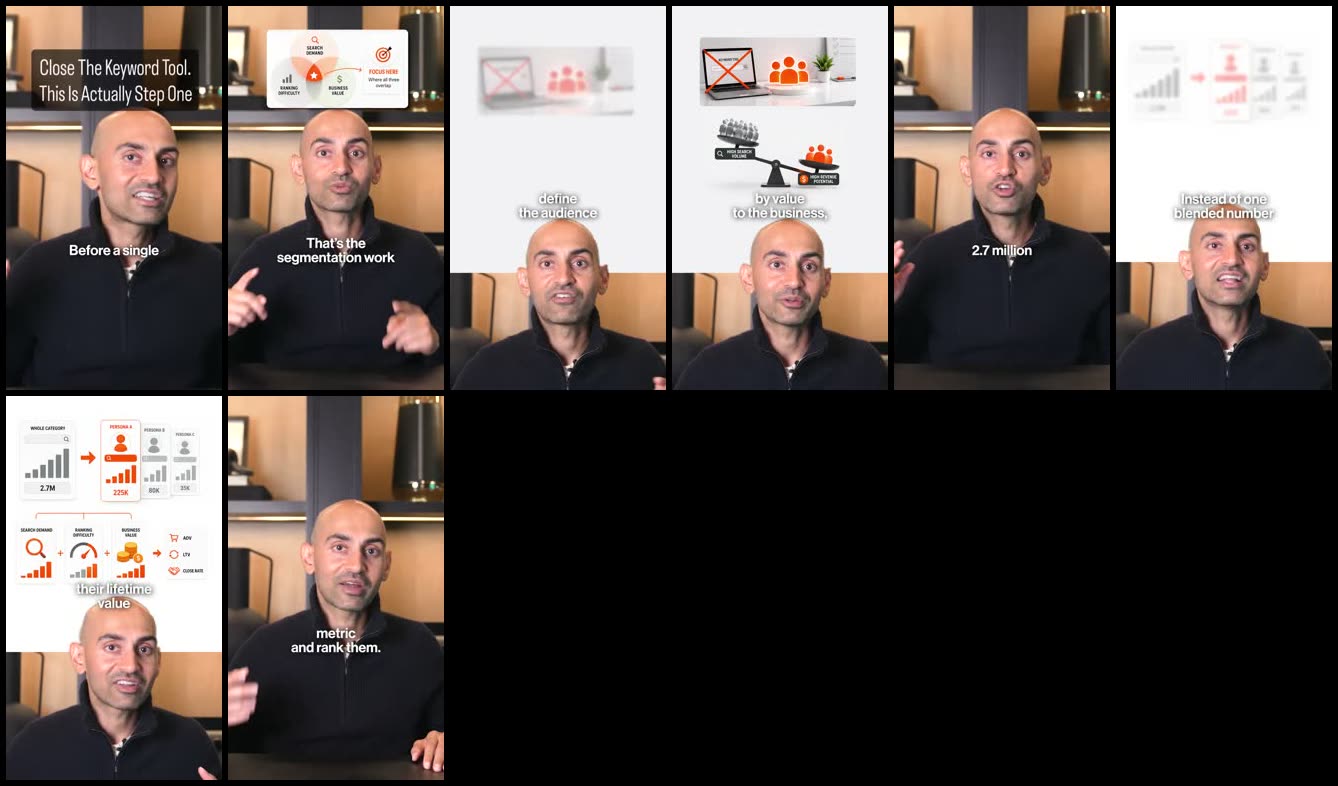
Kontaktbogen (8 Standbilder, zeilenweise; Zeitpunkte: 0.4s, 13.6s, 23.2s, 27.2s, 33.8s, 41.6s, 54.4s, 56.6s)
Verlauf
| Messung | Alter | Views | Likes | Komm. | Label |
|---|---|---|---|---|---|
| 09.09., 09:10 | 9.8 d | 5.827 | 74 | 8 | t0 |
t0 = erste Erfassung, t7 = etwa 7 Tage, t28 = etwa 28 Tage nach Veröffentlichung.
Notiz
Caption
Same tool everyone else uses. Different order, different result. Move one, rank your segments by business value before you touch a keyword. Move two, size the market by persona, not one blended number for your whole category. Move three, score every segment on search demand, ranking difficulty, and value, then find the overlap. That overlap is your strategy.
#SEO #ContentMarketing #SEOStrategy #DigitalMarketing #Marketing
Transkript (scribe, 229 Wörter)
anzeigen
Before a single piece of content got written, the team ranked every segment by three things: search demand, ranking difficulty, and long-term business value, then built the keyword and content strategy around the segments where all three overlap. That's the segmentation work most brands skip. If you wanna run this yourself, the process comes down to three moves. Here's how to apply it. Three moves, same tool you already have, different order. Move one: define the audience before you open a keyword tool. Rank your customer segments by value to the business, not by size, because a segment with the most search volume is almost never the one with the most revenue potential. 2.7 million searches in the big segment, and the money was in the one 12 times smaller. Move two: size the market by segment, not topic. Instead of one blended number for a whole category, break it down by persona. Score each segment on three things: search demand, ranking difficulty, and business value. And, and by business value, I mean looking at the average order value, their lifetime value, or their close rate. Pick your revenue metric and rank them. Then map where all three overlap. That map usually surfaces a small number of segments where the opportunity is real. Enough volume to matter, low enough difficulty to win, high enough value to justify the work
Weitere Posts von @neilpatel
alle
0,2×*
Bild
This is where 58% of marketing teams fail.
Nur Text / GrafikFallstudie / Proof
18 Likes18 ♥1 💬
1,8×*
44s
Reel
Ranking number one on Google is an entire game. It's barely half the game now.
B-Roll mit TextTutorial / How-to
11k Views216 ♥2 💬

0,7×*
37s
Reel
AI now writes half the Internet's new content and earns a 20th of the reward.
Talking Head + B-RollFallstudie / Proof
4.795 Views62 ♥8 💬
0,8×*
Bild
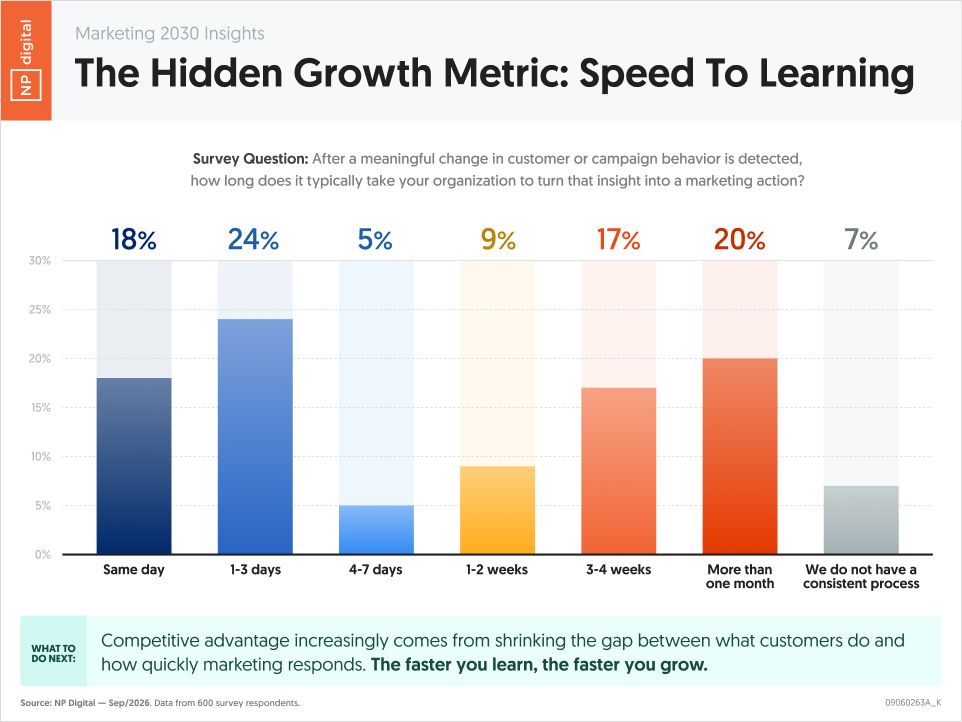
The Hidden Growth Metric: Speed To Learning
Nur Text / GrafikFallstudie / Proof
58 Likes58 ♥8 💬

0,7×*
1:19 min
Reel
Google about to lose AI Overviews??? Penske Media, that's Rolling Stone, Variety, Billboard, Deadline is suing Google.
Talking Head + B-RollNews-Kommentar
4.342 Views64 ♥7 💬

0,6×*
48s
Reel
Your readers can't tell it's AI, but Google can, and nearly every major AI company adopted the tech that makes it possible.
Talking Head + B-RollNews-Kommentar
3.866 Views46 ♥5 💬