anzeigen
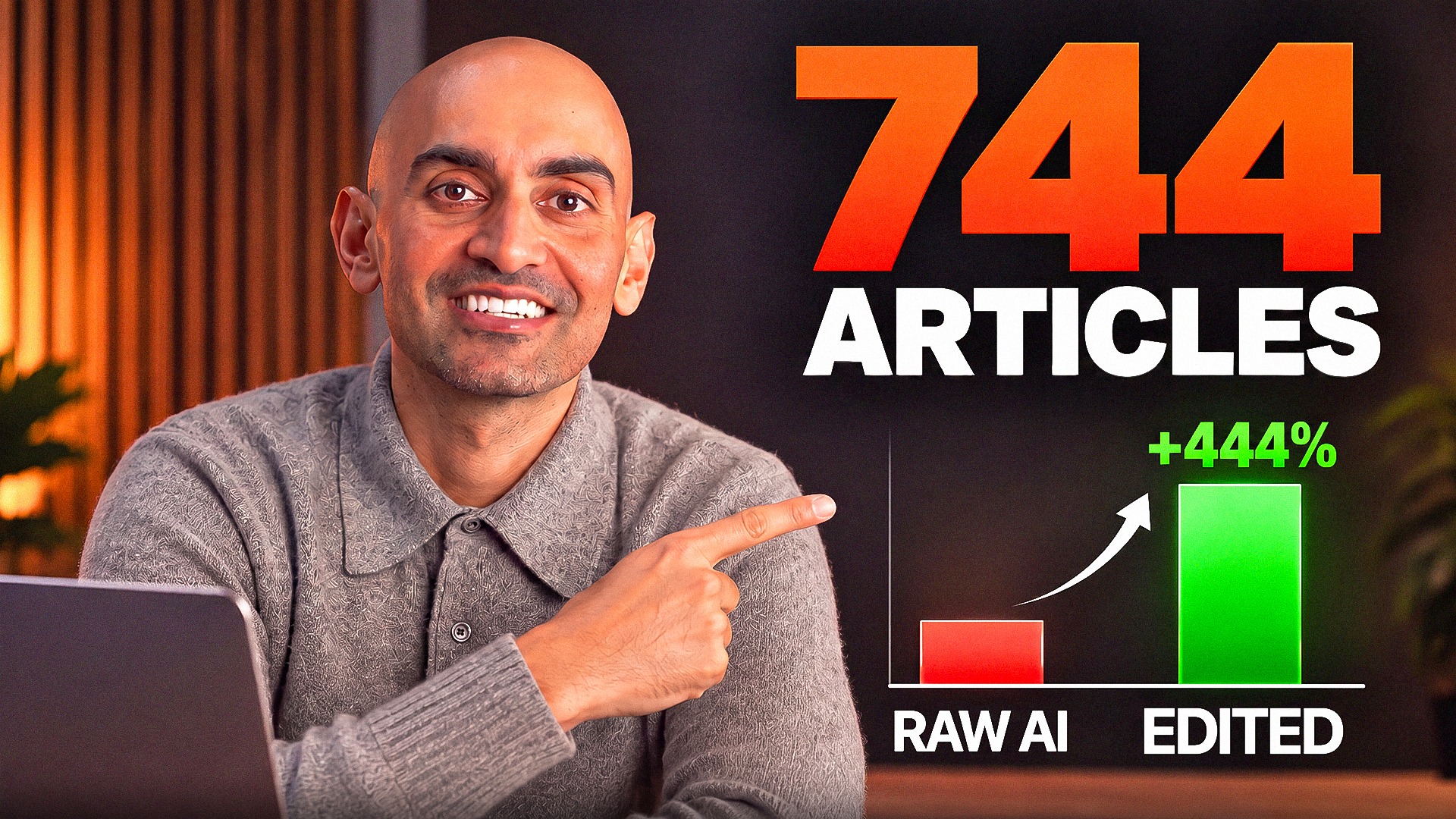
We published 744 articles across 68 websites. Half were written by AI and published exactly as the machine wrote them. The other half got one extra step before going live. That one extra step produced 444% more traffic. Everyone is arguing whether AI content works. We stopped arguing and tested it at scale nobody else has. By the end of this video, you'll know exactly what that step is, the mistake millions of businesses are making every single morning, and why Google always knows when you make it. Chapter one: The mistake you can't see, but Google can. Your readers can't tell it's AI, but Google can, and nearly every major AI company adopted the tech that makes it possible. Why does raw AI content feel like it's working right up until it doesn't? Because AI content is cheap, it's fast, and honestly, it reads fine. We analyzed 1,000 articles with a panel of readers, and most people could not reliably tell the AI-written articles from the human ones. So every morning, millions of businesses hit publish on machine-written pages, confident that nobody can tell the difference, except one reader can tell every single time, and that reader is Google. Google built a technology called SynthID. It invisibly watermarks AI-generated content. Text, images, video, audio, you can't see it, and neither can your readers, and Google didn't keep it to itself. Look at who's adopted its watermarking tech: OpenAI, Anthropic, Nvidia, ElevenLabs. Microsoft watermarks too, even Grok partially. Notice the pattern? Nearly every major AI platform is stamping its output with Google's own detection technology. So the content your tool spits out may be carrying a fingerprint, and the referee owns a scanner, which means the real question was never whether readers can tell. It's what happens when the algorithm knows. So instead of arguing about that, like everyone else, we tested it at scale nobody else has. The 744-article test. Everyone has a hot take on AI content. The problem is almost every take you've heard is either pure opinion or a five-post experiment on somebody's hobby blog. So instead of adding another opinion, we ran the test. 744 articles across 68 real websites in different industries on matched topics. Same kinds of keywords, similar difficulty, real sites, real clients, real stakes, not a lab demo, and we isolated exactly one variable. Half the articles went live exactly as the AI wrote them. The other half got a human editing pass first. The editing pass was the only difference between the two groups. So whatever the results say, keep in mind that this isn't based on a gut. As far as we know, it's the largest controlled test of AI content anyone has run, and the result was not close. Human-edited AI content didn't win by a margin of error. It won by 444%, and the gap widens over time. You'd expect the edited half to win by a little, 10, 20% margin of error stuff. The human-edited stuff earned 5.44 times the traffic, a 444% lift from one editing pass. And if you wanna see which pages and keywords are driving traffic to your own website, enter your domain name into Ubersuggest. It'll show you where your organic traffic is coming from and where it's beginning to slip. The link is below. But the finding that the study shows will actually change how you operate your marketing over time. The gap keeps growing because raw AI content decays while edited content compounds. We've watched it happen in real time. In an earlier experiment, after a single Google spam update, our pure AI sites lost roughly 17% of the organic traffic. The human-edited sites lost about 6%. Same update, same day, one-third the damage. And our newest research explains part of why. When the document goes through repeated LLM passes, the document is quietly corrupt. Errors and sameness stack with every pass, and each generation drifts a little closer to average. So unedited AI content behaves less like a discount version of a real content and more like a depreciating asset, worth the most on the day you publish and a little less every day after. And before you think this is just our data, the entire market is now saying the same thing. The whole market just voted. AI now writes half the internet's new content and earns a 20th of the reward. The market already priced it. We analyzed 100 companies to see what's actually being published and what's actually earning traffic. Two numbers tell the whole story. AI now writes 52.1% of all new content. The production war is over, and AI won it. But that 52.1% of content earns just 4.9% of the organic traffic. Now, flip it. Human-written content is down to 14.5% of what gets published, and it takes 87% of the traffic. Half the internet's new content is fighting over a 20th of the reward. And if you're thinking, "Fine, I'll just have someone lightly touch up the AI draft," the data says the light touch barely moves it. AI content modified by a human makes up 27.4% of what's published and earns 8.1% of the traffic. In fact, across this whole data set, AI content rarely exceeds about 10% of the site's organic traffic, no matter how much of it you publish. This next part isn't even our data. Lily Ray, a SEO expert who I've followed for years, studied 220 websites that leaned hard into AI content, and we charted her findings. 54% lost 30% or more of their peak organic traffic. 39% lost half. 22% lost three-quarters. Some even ended up lower than when they started this whole campaign of publishing AI content. And audiences are voting the same way the algorithms are. On social, human-made posts earn 2.15 times the likes and three times the saves of AI posts. And having the human lightly modify the AI posts barely moves those numbers either. People can feel it. And if you say, "Oh, people can't tell the difference," well, a lot of the social platforms, like Instagram, label when something is AI-generated. LinkedIn even has a button, and millions of people have been pushing it. And on LinkedIn, when you publish AI content, your friends will only see it. If you publish non-AI content, your friends and other people on LinkedIn can see it. So the market has already priced raw AI content. The price is near zero, which raises the real question: What are Google and the AI engines actually detecting? Trust is the ranking factor. Google says there's no AI content penalty, and that's true. It's also why everyone is fixing the wrong problem. And there's a rebuttal coming in the comment section, 'cause someone's gonna disagree and be angry, and it deserves a real answer. Google's official position is that it doesn't penalize AI content, and that's true. A public study of 600,000 pages found no correlation between AI usage and ranking position. Also true, and I'm not gonna pretend otherwise. But no penalty and safe are two different conclusions because a penalty was never the mechanism. Detection plus evaluation is. The engines aren't scanning for AI and docking points. They're asking a much older question: Who said this, and can we trust them? We surveyed the trust signals AI engines reward across six platforms. Look at what sits at the top. Expert authors, third-party citations, brand mentions, real experience, original data. Now, think about what raw AI output actually is: a statistical average of everything already on the internet. It's average by definition. No first-hand experience, no original data, no accountable author, and average never gets cited, penalty or not. So both findings hold at once. There's no ranking penalty for AI content, and raw AI content still earns a fraction of the traffic per piece. The study measured ranking positions, while we measured business outcomes, which means those humanizer tools shuffling around synonyms are solving the wrong problem. Hiding that AI wrote it doesn't add trust. The fix is adding the things AI can't have. And no, the answer is not stop using AI. We use it on all 744 articles. What separated the winners happened in the last 20 minutes before publish. The 20-minute human layer. The one content writing step that produced 444% more traffic takes about 20 minutes, and it's five specific moves. So what was the step? What did the winning half of those 744 articles get that the losing half didn't? It wasn't a typo pass. Spellcheck plus a fresh intro sentence is what most people call editing, and that moves nothing. The layer that proves 444% does five specific things. One, inject first-hand experience, a real client story, a number from your own dashboard, proof that a human with skin in the game touched the page. Two, add something the AI couldn't know. Proprietary data, a specific example from your own business. If the same paragraph could appear on anyone else's site, it's not defensible. Three, cut the filler and tighten every claim. AI pads and hedges. It writes, "In today's fast-paced digital landscape..." Delete all of it. Four, fact check and refresh. In our survey, freshness is the number one citable factor at 91%. Update the stats. Kill the dead links. Make it current. Five, put a real author on it. A name, credentials, a face that stands behind the claims. That's the whole layer, and it takes at least 20 minutes per article, and in many cases, it may take more than an hour. And our data forces one more rule. The rescue works for search. It doesn't transfer to social, where people want more people. Remember the double likes and triple saves? So on social, AI handles ideation and research, and a human does the writing. The rule we now run at NP Digital is simple. AI writes the draft. Humans make it worth ranking. Edit for search, create for social. And the way we look at content is if a human took two hours to write a piece of content at NP Digital, we still wanna spend two hours even if we're using AI. We just wanna make it that much better. AI should help you get more out of what you're looking for, not cut your time down in half. Instead, you should output something that's way better than a human can write on its own. And if you want our team to build and manage this kind of SEO and content for your business, that's exactly what we do. You can just hit us up at npdigital.com. Now, 20 minutes of editing brought roughly 444% more traffic. That is the best hourly rate in marketing. So use AI. Seriously, use it on everything. Just never let it hit publish, and make sure you always have a human in the loop. And if you're saving time because of AI, spend more time with your humans to even create a much better output. The exact five-step editing checklist we use on all 744 articles is in the description. It's free. Steal it. And if traffic keeps getting harder, even when your content is great, that's not you. Google changed the deal that built the whole internet, and I broke down exactly how with data right here.