anzeigen
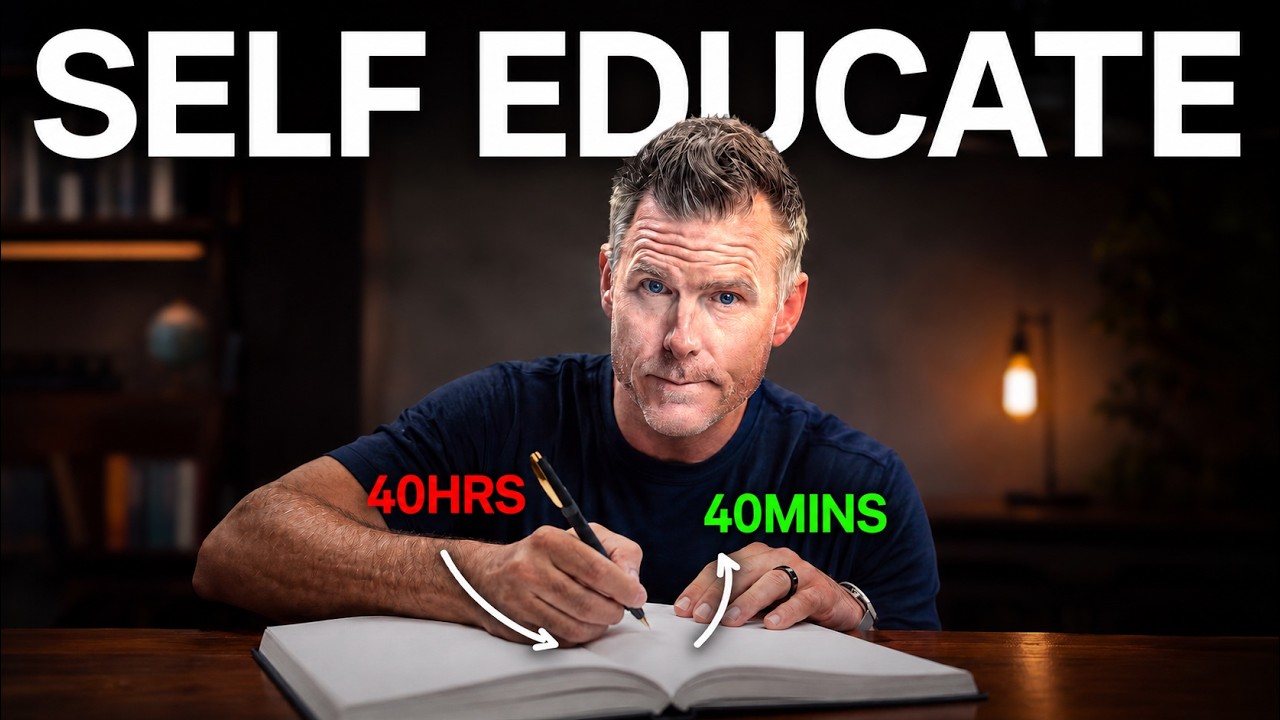
What do these great minds have in common? Henry Ford left school at 15 and taught himself mechanics on a farm, and he later became the world's second billionaire. Walt Disney, the guy who reinvented the whole animation industry, dropped out of high school at 16. Even Elon Musk taught himself how to program at 12. He's now on a mission to colonize Mars. Did you see the pattern? While everyone else memorized what they were told, they took it upon themselves to learn and grow. The system called them dropouts. History calls them legends. I got put on ADHD medication at 11. Taken out of my home at 12, and in my late teens I'd been in and out of jail. And it was in rehab where I saw it, a yellow book on Java programming sitting on a desk. And I taught myself to code from that book. That one book put me on a path that led to me building and exiting three tech companies before I was 35. And every bit of the life I have today. Here's the problem. The school system doesn't reward education, it rewards memorization. And that's created a generation of people addicted to what I call shelf-help. Reading books, binging podcasts, buying freaking courses, and doing nothing with any of it. Trust me, I have my own graveyard of courses. You're not the problem, the method you inherited is. Today, the tools to self-educate are better than any classroom. So, in this video, I'm going to teach you my self system. Seven steps to teach you anything with AI as your unfair advantage. Your education in your own hands. Starting with select it. What should I actually learn? There's a gap between what most people learn and what people actually need to learn. Growing up, your parents picked for you. Schools picked for you. Today, the algorithm is picking for you. It feels like learning, but it's so much wasted learning because it's just for learning's sake. So, for once in your life, let's take that power back. And to do that, the first thing you need to understand is point one, just-in-time learning. We either learn just-in-case, meaning in case something happens, or we learn just-in-time, which is the thing we need today. Think about school. They made me study facts about history that have never come up in anything I've ever done, but it was just in case. Then I get into business and I realize that if I learn how to hire people, I can use that today and it'll help me just in time. Trying to memorize something just in case doesn't actually make the retention show up because if I'm trying to learn to solve a problem that's there today, man am I ever going to focus on it. You don't need more information that's just interesting. You need more execution, the doing. Here's how we solve this. Just ask yourself one question. What problem is this helping me solve? If you can't point to it, that's shelf help. So, how do we figure out what you need right now? Here's where AI changes everything. We just point to Don't ask AI, let AI ask you. When I'm talking to my AI, I have it ask me the questions. I say, here's what I'm trying to do, here's what I'm trying to solve, the just in time thing, and then ask me questions to give it context so it can give me the best answer. AI already knows everything about business and strategy and tactics, but it needs to know your business, your goals, your gaps. This is the first time in the history of the world that the technology you're using can actually teach you how to use it better. Whatever excuse you have before about not learning it, it doesn't exist now with the world of AI. And I'm going to teach you in this video how to educate yourself in a way you've never seen before. Here's exactly how I do it. The first thing is I give my AI a prompt. And this is a big one, but it'll be below in the description. I want to self-educate myself on topics that'll help me solve the biggest problems I'm currently facing. I don't want shelf help, no learning for the sake of learning. Use everything you know about me. Then interview me to figure out where learning something new would have the biggest impact. Then do a deep research project to build me a list of resources to learn from. I believe in just-in-time learning, not just in case. Only recommend things I can apply immediately. Don't give me the most popular resources. Give me the ones that fit my current struggle and then deliver it to me as a spreadsheet with the resources, the format. I'm talking books, podcasts, creators, courses, the link and why you picked it for me. If anything's unclear, ask me before you start. And I don't know if you noticed this, but I used my MAPS framework for prompting it and if you don't know what it is, I'm going to link it at the end so you can watch it. Now here's a pro tip. If you're using Claude, just ask it to use the ask user tool feature. The thing is it'll then interview using multiple choice checkboxes for the whole thing. It'll even let you rearrange the priorities of different things that it might find, but it's super visual, super interesting and it makes it super easy for you. Once you give that prompt, you have to make sure you answer honestly because garbage in equals garbage out and the curriculum will suck. It'll then hand you a custom learning list built for your exact struggles >> [music] >> and then we pick one. One of the resources, not all of them. Don't get overwhelmed, just realize one. Start there. I get picking something is tough because you're worried you're going to pick the wrong one and that might not teach you the thing to get you the result, but I'm telling you this skill to develop right now when we talk about self is selecting anything and building the skill of getting to the next step which is going to change your life. By the way, if you want to see how I use AI beyond just learning, I put together a complete guide that talks about the departments in my company, marketing, sales, ops, all of it on how I do this. So just find me on Instagram and DM me the word AI business and I'll send it over to you. All right, so now you know exactly what to learn, but here's where most people blow it up because they don't know how to take it in which brings us to the next part, the E, extract it. Think about school. [music] When you're in class and you're learning like math and biology and history and you're trying to learn all these different topics within the same day, how can you possibly go deep and really retain any of it? So what we're going to do is the opposite which brings us to study, don't read. Everybody wants to read and listen and consume, but they don't actually study. Study is way different. Most people read a business book like a novel, cover to cover, and they read all the stories and they're getting motivated, but that's just consumption. Nothing sticks. It's almost like fast food, and nothing changes in their life. Studying means you're looking to extract something. You're looking and you're hunting to actually implement, not just tour around. When I'm learning a topic, I got to get obsessed. Because if you're not obsessed, you're just interested. And guess what? Interested people watch obsessed people change the world. All those people I mentioned at the beginning were all changers. Obsessed. So, there's a few things you got to keep in mind as you study. And I'm going to draw them out because there is a big difference between study versus read. The first one is you have to have the daily dose. One of my non-negotiables is every morning I read 10 pages of a book. The key is is you want to make it manageable. I don't sit down and read 100 pages of a book, but if I do 10 and I'm studying and I'm looking for something, then what's cool is when I go to bed that night, my brain gets to process all the things I learn, and then the next morning, I wake up refreshed to go study again. What happens is because I'm learning every day, I've created a habit of studying that my mind is always on the lookout for new information. The second one is we have to come prepared. That means that you have a place where you go study. When I come to learn from somebody, I don't just show up. I sit down and I'm ready to go. I've got everything I need to learn because what I've discovered it's what's caught, not taught. It's not necessarily what I read in the pages, is what I was inspired to think about, and I need to capture that so I don't lose it. Number three, study, rewrite. This one changed my life. A long time ago, I was reading a book and the author talked about how when he studies, he rewrites what he learned in his own words so that he can internalize it. And that is pretty much what I've done with every one of my books. As I'm listening or reading, I'm rewriting it into my phone. So, if I go on my phone right now, I will show it to you. I have a notes file with everything I've ever been inspired by that's resonated with me, all the information, and I literally rewrote it all in my words. Look at this. Let me show you how long this document is. You want to always be in rewriting and rewriting in your own words. So, if I say exhaust the body, tame the mind, guess what? That's a quote from the Greeks. I know that's not what the quote is because I rewrote it, but that's how I think about it. And that allows you to study in a massive way. And then the fourth is you have to pick one all caps action item. You might notice a theme here. I'm not trying to boil the ocean. I'm trying to pick one thing and study it. If you wake up every day and get 1% better, one tactic better, one idea better, you're going to wake up in a year completely different person. And that is why this book, Buy Back Your Time, is written the way it's written. Each chapter literally sets you up for the next thing, from the time audit to the inbox and management to then learning how to delegate to other people, the camcorder method, how to hire people. Every chapter was designed for you to study, do, and then come back and read the next page. Stopping, reading, synthesizing, it's actually a scientific term called motor learning consolidation. Every night, as we learn things and do things, our brain will resort and restructure so that you can come back the next day with better skills. And here's a pro tip. If there's people that you follow on social media, but they've never written a book, but you're like, man, I'd really love to study this person and learn more about this topic from that person. I actually use AI to create a prompt called the book architect that I can give it a person's name and it will write me the whole book outline with stories and frameworks and everything that it extracted from that person's online public content. I've used it to learn mindset strategies from people that have never written a book on the topic, but I follow their content all for you for free. And if you want that prompt, it's below in the description. Now comes the fun part. Point number four, we got to feed our mind. I have a completely different approach to social media than most. Some people are like, "It's bad for you. Don't use it. Don't let your kids use it." I use my social media all the time to feed my mind. My consumption becomes my education. So, we have to feed your mind. We got the drip and this is daily. These are things like your daily brief, your newsfeed, everything that you need to consume to give you context on what you're up to. So, to get the drip, first thing is you go to Claude or ChatGPT and you give it this prompt. "I want a daily brief on your space." Whatever space that is. "Find the most relevant sources and pull from podcast, X [music] profiles, Instagram profiles, newsletters, news sites, and then every morning scrape them and gather the best insights into a 10-minute brief I can read with my coffee. Only include the relevant things that I'm learning right now. Cut the noise out. I don't need clickbait. I don't need distractions. I don't need things that repeat themselves. That'll give you a beautiful daily report that will get your brain ramped up. That's using my feed to feed my mind. Now, the pro tip is as it gives you the report, look at the sources and follow them on social media. That way it updates your feed with more of the new stuff as it comes live. So, if you're just scrolling while you're waiting in line somewhere, you're going to get the good stuff before it even feeds it to you. The other way is to do a deep dive. This is the one thing you've decided, the thing you've picked to go deep on, the thing you selected. Right? Remember we talked about that one thing? Now, how do we go deep on this? Well, we go to things like Notebook LM. Right now, it's the best one, where you can give it a topic that you want to go deep on. It'll pull the research, the videos, the PDFs, everything it has online because it's built by Google, and it'll allow you to create a custom AI to just quiz and learn and interact with it. And what's cool is it will create videos, podcasts, >> [music] >> graphics to help you learn even better. This is the stuff schools were never able to do that we can do today in the world of AI. So, if you're a visual learner, that tool will change your life. The real pro move is to combine and automate these two processes. Actually get your daily chat to feed itself automatically to Notebook LM, so that every morning you get the video, the podcast, and the graphics on the topics that are relevant to you. The just-in-time, the daily dose is now automated, so you can go deep on the things that'll have the biggest impact on your life. Now we've got all the right information, it's flowing in every single day. But knowledge flowing in is exactly where shelf help starts. So, we don't want that to happen. The next part in the Shelf acronym is live it. We know what we need, we know how to consume it, but how do we make it stick? This is where shelf help goes to die. This is where we make sure we fight against it because it cannot win. We actually want to get the results of the learning. And this is the hard part because learning feels wildly productive. But here's a harsh truth, AI can't do this step for you. AI has gotten us to this step as fast as possible in a way that is completely revolutionary, but now we got to do the work. So, the first thing we have to do is set a deadline on the learning, which is point number five, the 48-hour rule. If you learn something and you didn't act on it within 48 hours, then you're doing shelf help because everything you learn has a shelf life. Everybody wants to talk about motivation. Here's what I've learned. Momentum comes from movement, not motivation. If you want to be motivated, make movement. Here's what we're going to do the moment we learn something. First, we're going to translate it into your world, right? Remember we talked about rewriting the words? But now we're going to go one step further. You might take something like you've heard me say the quote, "Exhaust the body, tame the mind." So originally it was some Greek quote, I rewrote it into that, and then the live it part was I'm going to the gym tomorrow. Skip the to-do list. It goes straight into your calendar inside of 48 hours cuz we don't want to put it in the to-do list where it goes to die. It's like when I learned the height framework, hook, explain, illustrate, teach. Soon as I learned it, I then spent the afternoon practicing it live in front of other people. I was doing a podcast, I did it at the podcast. I was doing a training with my team, I did it at the training with my team. I had to go shoot reels, I practiced it while I was shooting those reels. I practiced it in real time within that 48-hour block. Why? Cuz I want to integrate it into my life. So now you're doing it and you took the action. How do we make sure that we really understand it? See, there's a way that all the doctors know that nobody else gets taught, which is called the mirror test. When you go to get your medical degree, they say, "You're going to learn it, you're going to do it, and then you're going to teach it." See, teaching is the mirror. When you actually study a book, not just to learn, not just to do, but actually to get ready to present it to somebody else, you're going to study in a completely different way. I remember reading this study by Yale and they asked a bunch of people to explain zippers. And but before they asked them, they were like, "Do you understand how zippers work?" They're like, "Yep." They're like, "Cool, explain it to me." And then they realized that they didn't actually know how a zipper worked. So people can think they know something, but because they can't explain it, they don't really know it, which means it can't teach it, which means it's not integrated. So here's how we do the mirror test. First thing we got to do is just think of somebody that you know, ideally that you're going to talk to, where they could find value in what you just learned. Then next time you see them, just say, "Hey, can I teach you something?" They're like, "Yeah, for sure." And then walk them through it, and be detailed. Try to break it down in a way where it's like you learned it, but now you're going to break it down in a way that they can understand. Now, when you're done, have them repeat back what they heard. If they can repeat back a comprehensive answer, then you know you actually taught it properly, which means you know it, they know it, and everybody wins. If it doesn't come back right, then practice it with the next person. And I do this all the time. I literally hang out with people like, "Hey, you want to learn something cool?" They're like, "Yeah." I'll teach them a topic. They don't even know I'm doing it. But then when I'm done, I say, "Hey, repeat back to me what you heard me say, cuz I'm just curious if I explained it right." And they're like, "Oh, well, there's this, this, and this." And I'm like, "Mm, no, no, actually that is not actually how it works. All right, I got to work on it." That is the mirror test. When you can have somebody else mirror back what you learned, then you actually learned it. You studied it. It's deep. And here's a pro tip, if you don't have anybody around, you can literally talk to your AI. I use WhisperFlow. You can use whatever voice tool you want, where you explain it to AI, and then ask it to grade your explanation against the raw materials. Maybe you send it to link, to the thing you just listened to. And ask it, "Was I vague? Was I wrong? Was I unclear?" And have it flag the gaps in how you explained it, so they can reply and say, "Hey, that was good, but here's what you could add it to make it even clearer." So, we're using AI to teach us how not only to learn, not only how to live it and execute, but now how to teach it to other people. So, now we figured out what we needed to learn, so we're not just doing self-help. We figured out how to actually study it. We learned how to implement it. We learned how to even teach it. But there's still one thing left that decides how far you take it. Which is the F in self, which is forge it. Forging means how do I get great at it? How do I become masterful at it? Because I can just get something done, and that's cool. But if it's important to my life, I'm probably going to need to use it over and over again. This is about mastery. The The loop gets knowledge into your life. So, now I have it in my mind. This last step is what turns it into actual mastery. Point number seven, until you [music] can't get it wrong. Most people practice until they get it right, which is awesome. They get it once and then they move on. But, the pros, they practice until they can't get it wrong. They practice until that 360 on the wake surf gets completed and now 99% of the time they're landing their 360. You've probably heard the famous Bruce Lee quote, "I fear not the man who's practiced [music] 10,000 kicks once. I fear the man who's practiced one kick 10,000 times." That is mastery. I like to think about this in different levels of mastery. The first level is 10,000 hours. You may have heard this. Malcolm Gladwell made this famous, where he talked about mastery requires 10,000 hours of doing something. When I recently hired a coach to teach me how to wake surf, I brought in a guy named Austin Keen. The guy is a stud. The first question I asked him was, "How long have you been wake surfing for?" He's like, "Well, I actually started skin boarding when I was 10." Today, he's in his mid-30s. He's got way more than 10,000 hours, but that's where it starts. That's level one. And we want to keep going up with intensity. Then we have 1,000 days of dedication. Think about this, 1,000 days. And if you run the math, this is 24,000 hours of focus. Then, if we keep going up, we have 100 months of focus in study and attention for mastery. That works out to about 73,000 hours of focus. Then we have 10 years and that's over 80,000 hours of doing the thing. We all need to start somewhere, which is level one. But, level two, 1,000 days, 100 months, 10 years. Most people forget to get great mastery at anything requires a decade. When I started my YouTube channel, I wanted to get good. I didn't even think about great. I just thought, "Hey, if I show up for a decade every week and just published and practice using the SELF framework, then maybe someday I'd have 100,000 followers." We've got 3 million today. That is wild, but I ran the SELF loop and focused on one thing long enough for it to take care of itself because I decided to become a master at it. I went past the 10,000, past the 1,000 days, past the 100 months to a decade. And the truth is, I've never seen someone not change their life their whole life in 1,000 days. Remember the legends I talked about at the beginning? We've got four. We got Disney. We got Musk. Everybody you admire, they didn't wait for permission. They didn't need a curriculum. [music] And today we have AI, so we don't have any excuses. That one book in rehab changed my whole life. Imagine what it could do for you. Not to read it, but to study it. Not just to study it, but to do it. And not just to do it once, but commit to it. So, I want to know in the comments below, what's the one thing you're going to go and study? And if you want AI working in every corner of your business while you learn, DM me AI business on Instagram and I'll send you the guide. And now, if you want to learn the MAPS framework for how do you actually prompt with AI, I've linked a video up here. I'll see you on the other side.