anzeigen
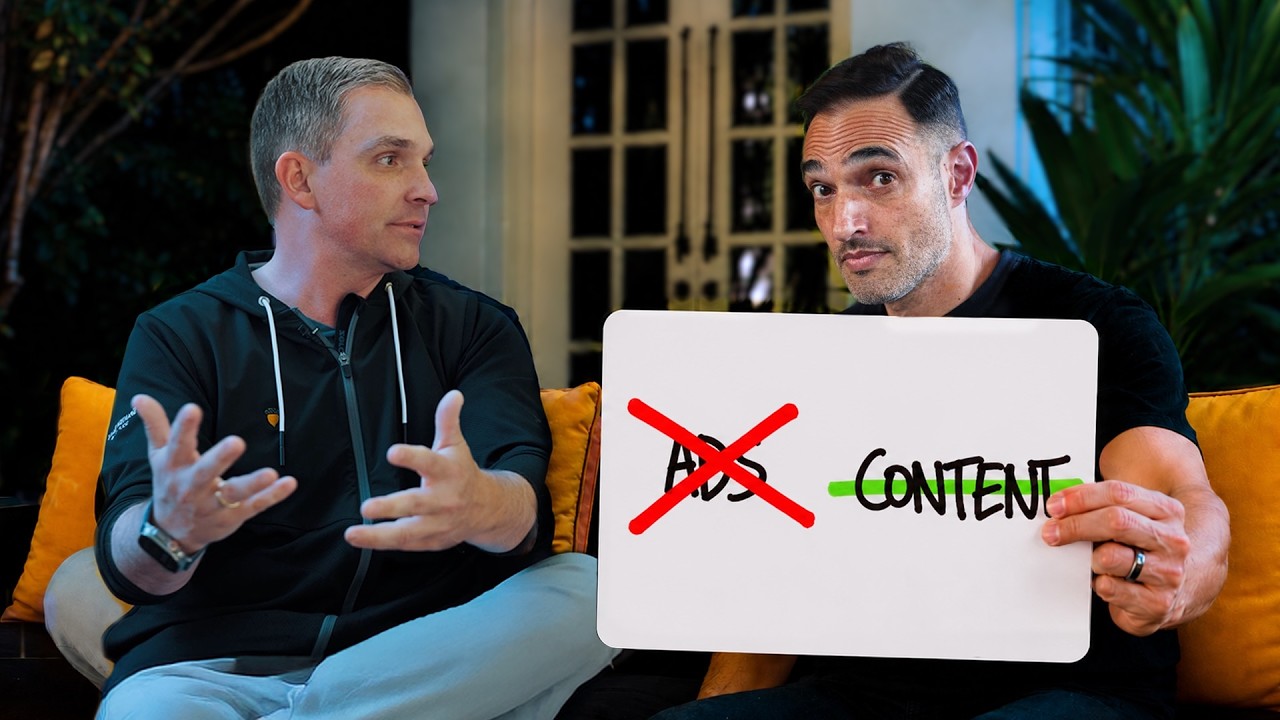
If you were spending a hundred grand a month on ads, successfully, mind you, it's working, what would you do? Would you keep them going, or would you turn them off for two months for shits and giggles, just to see what would happen? >> We went from spending about a hundred fifty thousand dollars a month on ads to spending about zero. >> That's what Ryan Deiss did. He's one of the OGs of digital marketing. He ran Digital Marketer for years. He's an [music] absolute genius, and really lucky to call him a friend and a client inside Boardroom. And on one of the breaks at our last event, I asked him about this crazy experiment. >> been running it now for for well over a year. No changes to any video, and it is now our number one channel of acquisition. >> out why did the experiment, exactly what happened, and what the lessons are for you as you want to grow and scale your coaching business, how much you lean on ads, how much you can lean on content. It's super juicy, super useful. Um Ryan reveals [music] everything, warts and all. Anyway, I think you're going to dig it. Ryan's a G. Enjoy. Thanks for being awesome. So, let's let's talk. I want to hear about what's working right now, cuz you've been doing this a long time. So let's start with uh why coaching. We can have as as much backstory as is needed and as little as possible. >> Sure. I mean, so for god, man. I mean, let's go back to 1999. >> [laughter] >> I like that. Great. >> As little as possible. >> Yep. >> No, I mean, so in 1999 was when I made my first sale online, and it >> What did you sell? >> It was an ebook on how to make your own baby food. >> Actually? >> Yeah, literally. And I I we don't need to get into the backstory of how that happened. I mean, basically, okay. But I was designing websites at the time. It was just trying to make extra money, and my first client was a lactation consultant. >> Yeah. Um and it was a little awkward being a 19-year-old, but uh uh she couldn't pay me. And um her husband had lost lost his job, and she's like, "Hey, we don't have any money. I got to give up my practice. And uh so, I don't need the website anymore, and I can't pay you. But I wrote this ebook on how to make baby food, cuz I wanted to get into childhood nutrition. Hopefully, you can make some money with it." And um and so, I was like, "Thanks for nothing, uh crazy lady." But um but I decided, "Why not why not give it a shot?" So, I I built a simple one-page website uh to sell this stupid ebook on how to make your own baby food. >> For how much? >> Uh $14. >> Okay. >> Um reason being uh the ebook had, I think, 28 pages and I was like, 50 cents a page sounds about right. >> deal. >> Yep. The bargain. Bargain at twice the price. >> 100%. >> Um and so yeah, so I that was the very first thing I sold. I remember You know, back then you could if you just just stick the same keyword you wanted to rank for at the bottom and you'd rank there. Like it worked. And I remember waking up and seeing I'd made a sale. I was like, what if I had a hundred of these? >> Yeah. >> And that was kind of where everything got started. So I've always sold digital products and courses. And then I got into manufacturing and e-commerce and all these other really, really, really complicated busi- businesses and round about 2018, 2019, we exited most of those businesses. >> Yeah. >> I was kind of trying to figure out like, what do I want to do when I grow up? What do I want to be? And I never really wanted >> Right. Thank you. >> Dude, you're even younger than me. >> So young. Thank you for saying that. >> By the way, it's fishing for that compliment and you It's kind of upsetting when someone younger than me is way better at almost everything than me. So kudos for being young. >> know that's not true, but thank you. >> true. >> There's a reason I I pay to be in your group and you don't pay to be in mine. >> Mostly cuz yours is about operations and I'm >> [laughter] >> I don't want anything about that. >> Fair enough. >> Yeah. >> But um but now I I never, ever, ever wanted to have a coaching business cuz I always looked at this and I was like, that is the most inefficient like dollars for money business model that that there could ever be. >> Well, there's more work than selling a lactation ebook. >> Bingo. And that that's kind of what what I had figured out, but you know, as as my frankly, stuff has changed out there and nobody really just wants to buy any book. They don't want to buy a course anymore. >> Yeah. >> Um just stand-alone, especially in the age of AI. >> Yeah. >> And so it we realized, hey, look, if we want to continue to have a have a business that will serve people, meet them where they are, we got to meet them where they are. We got to connect with them. And and coaching was a good vehicle to do that. So we set out set out to do it and I'll tell you, man, I've never had more fun in my entire life. >> hey. >> It's so good to get to connect with people, get in the trenches with them. And what I've learned is you can build a very, very scalable coaching business that doesn't require you to be in it all day, every single day. >> 100%. How many people-ish in Scalable right now as customers, clients? >> Uh we have kind of in our In our top level group is capped out at 120. And so we've got 120 there, and then across the board I want to say it's around I should know these numbers. >> no. >> Um it's it's around 4 500. >> That's awesome. Okay. So it's a it's a really strong, solid, stable business. >> Yeah. >> Um I want to talk marketing in a minute, but if you had to give me like one tip on designing, delivering a coaching experience that actually gets some results and is fun for the owner, what's that? >> So the the biggest thing that we made is that that the biggest change we made that that worked the best is There's all this stuff between like one-on-one. Do you do one-on-one cuz that's what everybody wants, or do you do you do um do you do group? >> Mhm. >> And um what what we figured out cuz our ideal client they're doing they're a business owner they're they're doing two to 10 million dollars a year, couple million bucks in EBITDA, but they're just like dying. Like they're drowning. And um and the I the idea of of just kind of plopping them immediately in a group program, nobody seemed that excited about it. >> Mhm. >> So we kind of created a hybrid where for the first 16 weeks >> Yes. >> it's they've got one-on-one with a coach. >> Yes. >> And um >> 16 weeks stand-alone or is it the first 16 weeks >> Yeah, good question. We've done both. >> Mhm. >> Um originally it was 16 The first 16 weeks we sold stand-alone for $15,000. >> Yeah. >> And then if you wanted ongoing support, then it would it would be $1,000 a month. >> Sure. >> Um for on for ongoing support. Um and originally our goal was like let's sell for 15,000 and then let's see if at the end we can get people to ascend. Well, only about nobody did. So then we started selling it where it was $15,000 and then the the 995 a month for ongoing was just baked into the contract and it was totally cancelable. >> Yeah. >> You could decide, but it was there and then most people did. >> Mhm. >> everybody did. Nobody bought. And then eventually we changed it to where now it's just a flat 2,500 a month as an initial engagement. Make it super easy to buy, super easy to get in. >> Yeah. Cuz we know people stay for years now. >> Um but that initial 16 weeks of delivering a very intimate intense one-on-one experience and getting them a result, >> what we found is that then we can back way off and the one-on-one is only every 90 days. >> Yeah. >> And now they're now it is more of a traditional kind of group program and so we can charge like a one-on-one, we can sell like a one-on-one because it is, but it's only that for the first period of time and after that we found that people don't really want this ongoing one-on-one I'm going to meet with somebody every other week. >> Yeah. >> Kind of thing. >> Yeah, it kind of manufacturing things to talk about cuz I got to call. >> Uh and it's very that's a hyper curriculum based, too. >> Yeah. >> And so we can just stamp that out now and scale it dramatically. >> Yeah, man. >> You've had a uh a bunch of businesses. Some of them have got your face stamped on the front page and some of them haven't. >> Yep. >> Uh I'd love to talk about marketing. A couple of Feels like a year Maybe it was 2 years ago. Maybe it was a year [clears throat] and a half. I was in Austin. We hung out. You took me to Terry Black's. That was great. Thank you. >> Yeah. >> And you were talking about kind of YouTube and this idea you had for a strategy. It's really good and we're running it and it's super great. >> Yeah. >> What um give us like the big picture of like what the what the marketing strategy is cuz you just did something super interesting. Like you turned off ads for 6 weeks to see what would happen. >> Yeah. We we went from spending about $150,000 a month on ads to spending about zero. Which which was scary. >> Yeah, of course. >> Um but I had to know. I I And we'll eventually start to slowly turn them back on, but I had I had to know and and we didn't really haven't really seen a dip substantial in leads or sales. Now I do believe it will start to peter down a little bit, but the organic is picking back up >> Yeah, yeah, yeah. >> really nicely. And so the the strategy is basically this. What I believe is that um the only thing that you can do to create trust in the short and sell cycles today from a tactical perspective is content benching. You've got to get people to consume a lot of content. It's basic romance relationships. You've got to go on a lot of dates. >> Yep. >> And that is when they're watching your content. >> they like go down the rabbit hole. >> Or one really yeah. And so the idea is like how do we do that? And in the past like when I got started um I think we have mutual friend Jeff Walker, right? Jeff Walker had the >> Product Launch Formula. >> Yeah, exactly that John. Um they had the Product Launch Formula and that was the whole idea of a product launch. Is let's basically have these three videos that we're going to drip out. We're going to send emails. People are going to open the email which they don't do that anymore. They're going to read the email which they don't do and then they're going to click on it and then they're going to go and watch a 20-minute video on this other landing page and they're going to repeat this process for about a week and a half >> Yep. >> while they while I pull them down. >> Mhm. >> It that was the ultimate content binge factory. >> Totally. >> I think of the kind of early to you know >> So the science is the same but the mechanics are different. >> Exactly. Now people don't want to just open email, click on it, go watch it somewhere. Now that binge factory is called YouTube. >> Yep. >> And when I realized that I said, "Oh, okay. Well, then what I need is the same basic structure of what happened in a product launch. I need one kind of main flagship VSL type >> Yep. >> video that needs to be as long as it needs to be. That's the video that's going to be my uh main video on my on my channels. So that the one that's right there in the middle when everybody goes. >> Yeah. >> That's going to be my be my VSL but I don't ever want that to be the first video that somebody watches necessarily. It could be the second or it could be the third. So now the question I have to ask is what are the other videos that would build into that? >> Yes. >> And so we started with five splinter videos that all linked back to that one and they'd also link to one another and if there was a relevant lead magnet they'd link to that. But then when you get on the list the second you get an email it's telling you to go watch the main pillar video. And so it just creates this this binge factory where everybody's bouncing from one video to the next with the goal of just getting them to watch that one video that I know if somebody watches this, they're likely to buy. >> Yeah. >> And that's a strategy that we rolled out about it was May 2023 was when we started testing it. >> Okay. >> Um and uh and and got really serious about No, I'm sorry, May 2024. >> Yeah. >> Cuz it was right after we talked about it. >> Yeah. >> And um so we've been running it now for for well over a year. No changes to any video and it is now our number one channel of acquisition. >> Yeah, same with us. >> It's crazy. >> And nurture. Acquisition, nurture. >> Yeah. >> It just works. >> Yeah, and so every week it feels like there's a new super useful video from you. Um and do do they all have a link back to this kind of one flagship VSL? >> So my my thing is link back to whatever makes the most sense. >> Because at this point now it could link to anywhere in the ecosystem and it's all going to wind up going back there. And so as long as I'm linking them to a place that makes sense they'll keep watching. >> Yeah. >> And then they'll eventually find a video that links back to the main one. And it'll happen in the right sequence, it'll happen in the right timing. >> Yeah, that's great, man. So they watch the let's just call it the VSL, video sales letter. >> Yep. >> Uh where do they go from there? >> For me it is a it's 120 minute long content video with subtle pitch at the end. It's basically a webinar. >> Yeah. >> Um and so from that it actually sends them to a traditional VSL, like a 15 to 20 minute video that really just is designed to make them product aware. >> Yeah. >> And then it's book a call. >> Yeah. >> And so that's that's the basic flow. >> Mhm. >> Um I think that I can tighten that up a little bit, but right now it's working so I screw with it. >> Yeah, I I want to be in it like well, messages is obscure keyword. >> Right. >> On Instagram. Um but it's a friction point for the you know, the right people get to the end of the right people do the thing. >> Yeah. >> Yeah, that's cool. Okay. So, how we like the thing I love about YouTube is it's got discoverability. >> Yeah. >> Uh which more and more is happening with short-form stuff as well. How does your your your short-form game's gotten really good lately. >> Thanks. >> Um >> Have a have had a lot of help. >> Yeah, yeah. I mean, all of us have, right? Uh explain your short-form strategy and is it does short-form link to long-form or it's it's a beast of its own? >> Right now, I'm treating it as as its own thing, but definitely So, I have short-form videos that are inspired by the YouTube videos. And in those, they do link back to the YouTube videos. But for the most part, the short-form is really just designed to meet people where they are, which is on that channel. >> Yeah. >> So, I think each channel is its own binge factory. And then what I want each channel to do is ultimately to get people on my list because then the job of the list is to send them to the channel they're not at yet. >> Yes. >> And to ex- So, it's really just more of an a an ecosystem expansion >> Yeah. >> time uh time piece, but um but yeah, I mean, we're trying all kinds of weird stuff on on short-form. I mean, I'm I'm doing stuff on short-form that I wouldn't do on YouTube cuz the medium uh allows for it. Like I can do these, you know, little book roasts. >> Do the book roasts. >> business books and things like that. And that was something I just wanted to test. They did really, really, really well. Um but what we also did on short-form is I took my best performing YouTube videos and I'm now creating a content series, like a value series >> Yeah. >> for short-form. >> links. >> Yeah, so those do. So, that is like a multi-part um so, I've got like a six-part video series >> Yeah. >> that they all link to one another, but that six-part video series is effectively inspired by a YouTube video that I know already worked. >> Yeah, yeah, yeah. That's good. >> So, we let YouTube test it out. If it works, then we bring it over as a video series into short-form. >> Yeah, that's good. Uh by the way, if I don't know where I'm supposed to look. There's three cameras going on right now. If you want to check out Ryan, search for him by name. No, by name or by Scalable? >> No, no, by name. Ryan, so Ryan Dice, D I S S. And man, I tried to do it with Scalable in the beginning. Man, this brand, when we launched it back in 2022, I tried for 18 months >> Dude. >> to launch it without me being the face of it, and it just didn't work. Um and cuz I was dead set on >> Yeah, I want to build a faceless >> Yeah, I want to build a faceless brand, and it just doesn't exist anymore. And I finally have had to realize like, no, no, no. >> This is your job. >> Yeah. >> That's the >> the number one, yes, you're a coach, your job is to be the face and the mouthpiece of your business. And the more you lean into that with great content, whether it's email or it's video or it's whatever, that's the that's the engine. >> And we're telling that to our portfolio companies that aren't even in coaching. I'm telling our CEOs of a company who's like, you're a benefits consulting you know, business, and yet your job, CEO, is to be the best spokesperson your business has ever known. >> Yeah. >> That's your job. >> Yeah. >> Hire functional leaders to do all the other stuff. Your job is to represent the brand. >> 100% Yeah, I love that. Um so you've gone from spending like most recently 100K plus on ads to nothing, and obviously that'll ramp back up, but this is a great test to look the system is stable on its own. Um should someone start short, should someone start long in terms of videos? Do you have a preference? >> I think you got to know, are you the kind of person who, like me and I think like you, is more likely to talk for a long period of time? Um blow V8s, my wife says I'm prone to monologue. Um and so for me, long-form is easier. And then if I've got something that works in long-form, I can chop it up. >> I think >> I know other people who they do much better short-form, and then if a short-form video goes, let's create an expanded one. >> I think the thing for me, I think about it as as skills. Like you've been teaching for a long time, and so you you've got that bit down. I think when you get start like imagine you're an early-stage coach, you got to learn learn your market, you got to learn content and teaching. >> Yep. >> And you're going to find your voice. And it's you you get more iterations, more reps in with shorts cuz you can do something every day. >> I agree. It also has a higher like better viral coefficient I think like on on those. So I would I think if somebody's like I don't know, I'm not sure, I'd say start with shorts just cuz the testing cycle that you get is so much faster. >> Yeah, yeah, yeah. So you I guess what I've heard so far is it sounds like content's kind of good. That's what I've got from this conversation so far. >> Content man is everything now. Um it it because it's just the only way to get awareness and attention. Like the idea of I'm just going to buy ads and people are going to care. I I think it's just >> that because you've been like you're in digital marketing for God's sake. >> Yeah, it breaks my heart. I mean, I loved the idea of just creating an ad, a direct response ad that just people clicked on and bought stuff or opted in for things. Like that's that was my bread and butter. It just doesn't break through right now. Everybody knows what an ad is. And so if the content that you're putting out on the social channels doesn't look like it belongs there natively, >> Yeah. >> it's just going to get ignored. >> Yes, like nobody watches the the ads at the start of a movie or on TV. >> So now all of our ads are going to go to amplify the content that has performed well. I mean, it's really really simple. If if if a piece of organic content performs three times better from like a comments, likes, like you you name the the thing, then then we're going to create an ad version of that with just a stronger CTA. So we'll recreate it as an ad as opposed to boosting because then there's no impact to the algorithm. And um and then that becomes the ad. And it's good. That that's that's now the only by and large pretty much the only types of ads we run with the exception of some retargeting to bottom of funnel product type stuff, but man, that's like 2% of the budget. You just can't spend enough there. Um well, man, I appreciate you putting me under this whole YouTube thing. It was that conversation that got me started and I'm I'm loving it. Never goes quite as fast as as you want. >> No. >> But even with a tiny little audience it like it it crushes. And it probably means that that we're doing it the right way. >> Mhm. >> I forget who said they're like the faster things grow the faster they die. Like if something grows like really really fast like a fish in the ocean, if they get like go from small to really big they they have a very short life. >> Oh, that's really encouraging. Thank you. It makes me reframe my crapness into awesomeness. >> There you go. It's me, too. I mean I when I go and look there's so many people with such bigger audiences, but I think if you're doing it the right way, you're you're building this these little communities of people who actually care. >> Yeah, 100%. That's good. >> Um >> Listen, this is a super hard segue to something completely different. We just hung out in Boardroom. It's a great squad. What's some what's one thing you've stolen from someone in Boardroom that's really helped like that's worked for you? I just want to like what's the tactic? Who'd you steal it from? We'll give them a shoutout. >> I mean I got it well let's go back to Jay Wright. Um we have never been able to make advisory like peer advisory boards work in any of our >> Mhm. >> What happened? You just getting getting them to actually do anything together. Like getting getting them to engage together. People will be very excited for like a week or two. >> Yeah, and then just not show or like yeah. >> Um and and yeah, and so that that's kind of the main deal, but we know like if we can get people in our in our groups to to connect with one another, that's the value >> you long term. >> Yeah. At some point we've kind of given everything that we got. >> got the stuff. >> We're sort of out of ideas. And yeah, I can come up with something new every now and then. Reality is they haven't implemented the old stuff. So the best thing that we can do long term both for their success and for ours is to get them to connect to one another and to see value in the community even over the content. But getting that done is hard absent coming to a place like this where there's like forced interaction. So how do you do it at scale? Well, you do the peer groups. Okay, fine, but like nobody actually does it. Um what what they're doing and how they've set it up is really is really smart. They they've got on essentially like a 10-week onboarding cycle that's like So, when you get with your group, uh it's it's 10 weeks, a call a week that is facilitated by a coach. And I think once you've got that going, >> There's Yeah. >> then it goes. So, it's basically teaching them how >> to work in a peer relationship. >> in a peer relationship. And so, that was a big takeaway. That's something that we're going to do, and I've watched him do it. And now I finally got the backstory. >> Yeah, that's good. And so, >> Yeah, man. >> That's going to happen, but I mean There's a dozen things. I mean, I'm here You you were giving me crap because I was taking notes >> on the YouTube stuff. >> Did I tell you? But, what you're doing that I'm not doing is you're taking your YouTube videos and you're allowing that YouTube video to inspire three short form, and then each short form has its own job. So, one of them is going back to the YouTube video, another one's going to a relevant lead magnet, another one's encouraging follow. >> Yeah. >> And that those three >> Yeah. >> of like these are the three jobs of of this That's brilliant. >> Yeah. >> That's great. So, I will be I will be stealing that as well. >> Do. Please do. Um Man, thanks for hanging. This is really fun. Uh There's a few firsts. You went in a blade. You went in a hot air balloon. You didn't die. >> I didn't die. It was close. I got the video to prove it that it almost landed on my head. No, but I was in the basket that got crash-landed on. Like, I literally had to duck cuz it was coming on, and it was But, it was it was And it was amazing. It was amazing. I'm so glad I was uh forced to do it. >> Yeah. Yeah. Man, thanks for showing up today. This is great. Um by the way, Richard's a bit of a ledge. Thanks for introducing me to him. >> Smart guy. >> Mhm. Smart guy. >> Makes me look good. Don't tell him I said that. >> I will not say that. >> Cuz basically, if I've ever said anything smart, it was because somebody on my team came up with it, and I just got to like mouthpiece it, and more times than not, it was Richard. >> Yeah. >> Don't. >> We've got we've got this whole strategy called brandwidth that accidentally came out of Tamara's mouth. She was trying to say bandwidth and just got it wrong. I was like, "That's a great idea. We're going to steal that." Yeah, and then all right, thanks for showing up. This was good. Fly home safe and we'll see you in Austin soon.