anzeigen
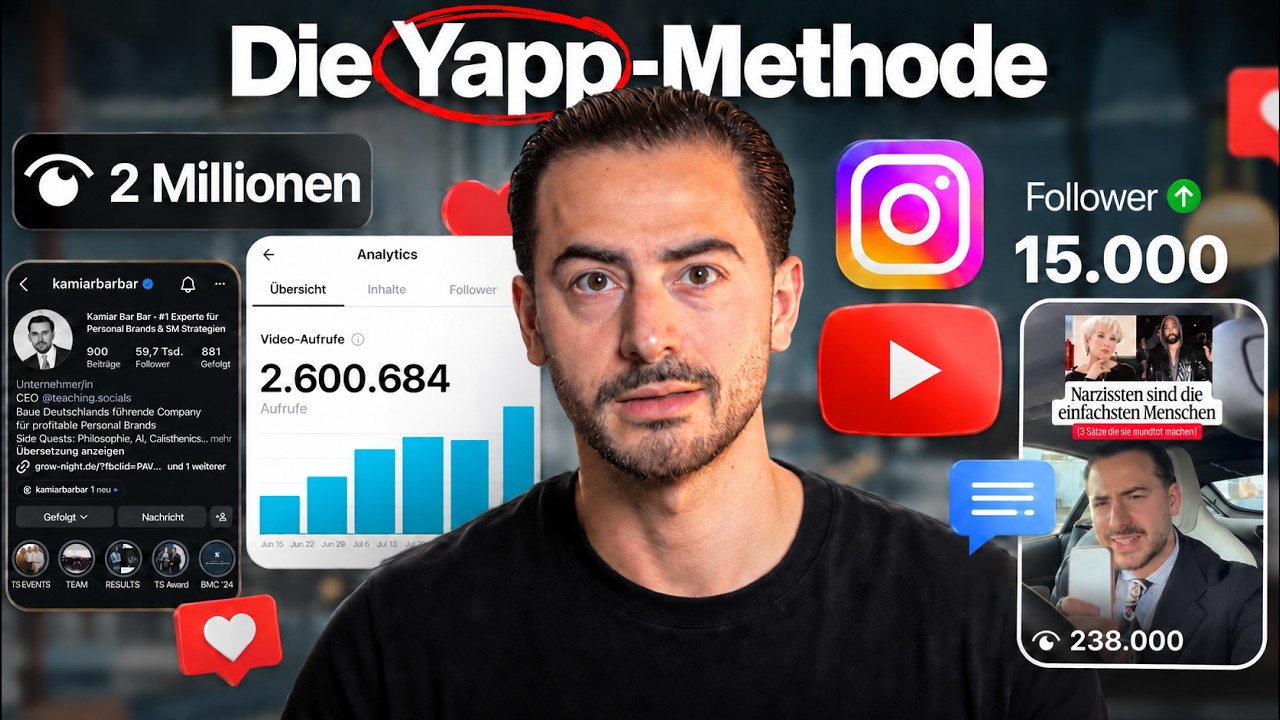
[music] Dismiss everyone. You mean all of them? Everyone quits everyone. Katter, the whole Kat, the entire team, even Peter, Peter too. Okay, to be honest, I've been watching this since January. Since January. We have, as Maurice said, the accounting report every month costs up to €9000 for category 8 and nothing changes. Since January we've been at exactly the same number and you're still using the same scripts or cutting style we used last year and nothing works, right? We pay for the studio, we pay for the people who do the editing so much, so that in the end the video doesn't even get 10,000 views. I mean, what kind of standard is that, right? I'm fed up with it. It's pointless. We want to become more profitable this year and we need to make progress. That's why I have to take matters into my own hands again, as harsh as it sounds. But fire everyone. You mean all of them? Everyone quits everyone. Katter, the whole Kat, the entire team. You can stay, [laughter] you will stay. So, I wasn't referring to you, but I mean all the freelancers we work with and so on. Everyone just quits , because even Peter is Peter. I'm doing it myself now. I'm doing it myself now. I'll show how it works, and most importantly, I'll show that it's not about adding another 10,000 effects. It's not about me showing you how it's done. How does it work, just like in the old days, where we took matters into our own hands? I even do the editing myself, and then at some point we can discuss it more and rehire people and start writing again. But right now, everyone's quitting, throwing all the f's out, I'm fed up with it . If we continue like this, we'll be paying €120,000 a year for nothing. That it's not growing, that it's not going viral. I'm fed up with it . Everyone quit, we'll stay, right, that we're talking about strategy , that we, that we wo n't neglect YouTube and beyond, I think, I have to say, but all the hangovers, it's no longer possible to get out. I don't know if that will work out well. Yes , yes, I have to make time . Okay, now I'm alone. I no longer have a team. I have no more budget. This is all I have left. But I also have a plan, and there's currently only one format that works on Instagram. That means Yap Videos, and I also know that it will only work for about another 6 months . Why? I'll explain that to you in a moment. And that's exactly what I'm going to do now . I have 30 days. I have my phone and I want to get 15,000 new followers with it without a studio, without an editor, and I don't want to spend a single cent on advertising. And you can see every number here now, even if I don't manage to do it myself. Before we begin, I need to briefly explain how I actually know this, because if I simply say that this format works, it's just an assertion, and there are plenty of those on social media. So, what happened to us? We made it really expensive for a long time. We had a good camera, we had plenty of lights, we had rented a studio, and we had someone to edit the videos . Not just one person, but several. A lot of money and a lot of time went into it. And a day of filming like that easily took up half the day, at least, until everything was set up. And then the video came out and almost no one watched it. It wasn't even like that from the start; it suddenly happened for months, and then something happened that I hadn't expected . I was sitting over the car and had a thought in my head. I didn't have a particular thought, just a thought. I grabbed my phone and started talking. I had no preparation, I had no script, I hadn't made a plan for it . I simply said what I was thinking, and then I did n't even spend 20 minutes editing it. Simply eliminate the pauses, upload quickly and it's done, and the thing took off . A video that I spent less than half an hour on performed better than anything I had previously spent weeks on or three rounds of feedback editing, and my first thought was that it was a coincidence, which is also the most obvious explanation. Sometimes things happen on social media that you don't expect, right? And nobody knows why. So, out of curiosity, I did it again, and suddenly it worked again, and again, and it worked again, and from that point on I knew it was no longer a coincidence, it was a pattern, and now to the question of why that is. The reason is actually quite simple when you think about it . Just take a look around on Instagram. What do you see right now ? You see hundreds, if not thousands, of people sitting in some rented studio. A black background, two microphones, [music], a podcast, always the same light in the background, and nobody listens to this podcast. Everything looks great, right? But everything looks the same and nobody notices when they realize someone is pretending. It's like when someone at a party is telling a story [music] and you realize they've prepared it beforehand. He either memorized the sentence or practiced the story at home by looking at the mirror. You listen, but you don't believe a single word he says. What people want to see instead is simply you, as you really are, with your completely normal voice in a normal situation, like being in a car without someone having perfectly adjusted the light on you beforehand . And that's exactly what you can achieve if you simply pick up your phone and start talking into it . That's the whole trick. And now for the second matter. Why do I say that this will only work for another 6 months ? Because every format eventually becomes obsolete. That's always been the case . I've been in this game for 7 years . At first, only a few people do it; it stands out because it's different from the rest. And the algorithm likes that because people stay longer. Then others see that it works and copy it, and it works for them too. Then there are even more people, and more and more do it , until everyone does it. And at that moment, it's no longer noticeable. It's no longer different, and then it's simply normal, and then it stops working because it's no longer special to people. And that's exactly where we are right now. Not everyone is doing it yet, but more are doing it every month, and that's why I'm doing it now and not next year. And it's the same with every format we've been doing for the last 7 years. Whether it was a split screen, whether it was the AB conversation that was reenacted, whether it was talking videos, whether it was the meme hooks, it's always the same. Or reaction videos, for a while it's always the same. Okay, I now know which format I'm going to use, but I don't have a single video yet, because I'm sitting here and I don't have any music at all. I have no theme, I have no script, I have nothing. And it is precisely at this point that most people get off the train. Not during the editing or filming, but right here at the beginning, when they don't know what the hell they're supposed to be talking about . And that's exactly where we'll start . [music] A video consists of three parts. The theme, the idea, the angle, and the format. And now I'll go through each one with you individually . The topic, the topic is simply what you talk about, and that's the most important part of everything because the topic determines how many people might even be interested in it. Imagine it like this: if you make a video about how to get a six-pack in 90 days, millions of people would be interested. Almost everyone would like to have a better body, and within 90 days. If you make a video about how to set up specific software for tax advisors, then maybe 2000 people will be interested. Both videos can be equally well made, but one has an inherent upper limit from the outset. You can use the best hook, the best setup, and even actors for the tax advisor video. The other one will reach more people. The angle is the stance you take towards your subject, and that's the point that almost everyone overlooks. I'll give you an example so you understand immediately. The topic is, for example, meetings. A completely normal topic that affects almost everyone who works, goes to school, or attends university. And now there are two possibilities. You can say that meetings are important. Here are five tips for better meetings, but nobody pays attention because everyone has already heard them a hundred times. So, everyone knows that meetings are important. Oh no, or you say that meetings are the biggest waste of time in every company and suddenly the video goes wild because it's an opinion and because many people want to disagree and because many people think, "That's exactly what I've always thought," and finally someone speaks up. The same subject, but a different angle with a completely different result because you have a contrasting take. The format is the packaging, meaning how the video looks and how you structure it. I'll go into more detail about that later, when we get to the editing. But it is only at the very bottom, much more important than anyone thinks, that the cut is made. The editing is the thing most people spend all their time on. They spend hours on it , making transitions, looking for music, yes, getting bogged down in details, beautiful fonts, and they may have only thought about the topic for 10 minutes beforehand . Exactly, that's the wrong way around . A perfectly edited video about a boring topic completely flops, but a moderately edited video about a powerful topic really takes off. If you take away only one thing from this video, let it be this: because all these agencies out there , who have never achieved anything of reality, sell the exact opposite with their poorly edited videos, but have no results. Why? because they have no idea about social media and don't know how good ideation works. How could they, if they themselves never went viral? Okay, I now know what a video in the Japping format consists of, but I still have to decide on a specific topic, and for that I ask myself three questions. A good topic deserves a year in all three categories. Question one: Are people even interested in this ? Does this interest enough people? We just covered that. If the topic only affects five people, then you'll only get five people if you send the maximum number. This does n't mean you always have to choose the broadest topic , but you should know how big the pot is that you can draw from. Question 2: Is this suitable for my customers? And now comes the mistake I see most often. I could make a video about how to get a six-pack in 90 days. Yes, that would probably go really well. I would have many views and perhaps many new followers, but I would still gain nothing from it because I wouldn't reach a single mobile broker or financial service provider. Exactly the people I work with. I might have a lot of followers who are interested in fitness , but they wouldn't buy anything from me . Never. And there's a model for that, called CCN Fit. This comes from Pdy Galloway, the YouTube strategist from Mr. Beast. And the three letters stand for the three groups you can reach. Core, these are your regulars, they know you, they've been following you for a while and they watch everything you do. Casual, those are the occasional viewers, they've seen some of your work before, they like you , yes, they might even follow you , but they don't watch everything and they're not necessarily your customers, and New, those are the new ones, I don't know them at all. The algorithm simply puts your video into the feed because it worked for the other two groups [music]. And a really good topic reaches all three groups simultaneously. Back to the meeting example. The video about wasting time in meetings works for CEOs. That's your chore, right, if you're selling, for example, a company boss , but it works the same way with any employee who has three appointments a day and doesn't feel like it. And these are casual and new. If a topic only affects the choir, then you do n't grow. If it only affects New, then you're growing up around the wrong people. But if it affects all three, then you're growing at exactly the right rate. The third question is, do I actually want to do it? That might sound soft, but it isn't. If I find a topic boring, it shows . You can hear it immediately in your voice, your pace, your face. It's obvious when you're talking [ __ ]. And I see this constantly with people who create topics because their agency said they would be successful or because their social media manager gave them the idea. They just talk it down and nobody gets stuck. Conversely, if you talk about something that is really on your mind, then that comes across and it's contagious. The energy automatically transmits to you via the camera. I simply write down 20 topics without thinking, and then I go through each one using the three questions. Anything that gets a year from all three of them stays, and the rest I cross out, and in the end maybe eight remain, and I work with those . How do I come up with the best ideas? The best ideas arise when I don't talk about the obvious, but when I find topics from my field with topics that would otherwise interest my target audience and combine them in a way that no one else has done before. It's like in music or in film. When someone comes along and imitates Michael Jackson, you think , well, he's just a copycat, you're like everyone else. But if you take elements of Michael Jackson and combine them with, I don't know, Nirvana, and create a new genre of music or develop the existing genre to your advantage, then you are new, and if it sounds good to you and people are really interested, then it goes viral. And the same is true for viral ideas. You shouldn't look at what my competition is doing and I'm talking about exactly the same thing, but rather at what my competition is doing that works well. These are validated ideas. And how do I connect [music] them? With my opinion, my perspective, or other things that also interest my target audience but have never been linked to this core topic. And if you manage to come up with ideas like that and see the world with different eyes, yes, you will never again have bad ideas or run out of ideas, because then you won't just have 20 ideas, but you will have 100 ideas, and from those you can then filter for CCN Fit. My team and I have always sat down and spent the whole week collecting different ideas, even before we had videos on YouTube that had gone viral with other formats. These could be news articles, but they could also be blog articles, YouTube videos, snippets from podcasts, or other Instagram posts from completely different industries that we sent together in a WhatsApp group with me. It's called the Creative Insburg Group, followed by the name of your channel, and everyone from your creative team—that's just me and Berkem for now—sends in their ideas all week long, and at the end of the week there's an ideation meeting where we sit down and filter them according to CCF criteria. The best ideas are included, and that way you'll never again have to ask yourself, "How do I even come up with good ideas?" So, now we have the ideas, how scripted the damn video is, or scripted in general, it's called the Jewish thing, there's a trick [music]. I now have my topic, and now comes the moment that most people dread: a blank sheet of paper. You know what you want to talk about, but you don't yet know how to start or how to talk. And then you put it off, and then you never make the video, and a very simple sequence can help with that. Four steps, always the same. And internally we call this the Agile [music] Framework. A for anchor, G for story, I for illustration or analogy, and L for lesson. I'll go through them one by one, and then I'll show you a complete example. Ah, the anchor, or the hook, that's the very first sentence. He has exactly one task: to make the thumb stop. The audience is gone and on they go before you've even started talking. A good hook or anchor does three things at once: visually, but also verbally. She says what it's about , she says something no one expects, and she leaves one question unanswered. This may not make sense to many at first, but introverted people make the best speakers, actors, musicians, and entertainers. Eight out of ten of the richest people in the world are introverted [music] and that is not a contradiction at all. Now we come to the story. Now you explain why this is important for the viewer . This is the part that many people skip. They launch straight into their tips, but the viewer does n't yet know why they should listen or why they should listen to you. So what good does that do him? What changes for him, and what story of yours can illustrate that? Why are introverts often the best salespeople or the best speakers, singers, whatever? Because they live so much in their inner world that they want to prepare everything themselves and not improvise anything . I myself am extremely introverted. I'm always the biggest show-off on stage, at events . But in the past, I was the biggest victim myself, always saying that I was introverted because of this or that I had ADHD because of this. I have ADHD, which is why I can't concentrate. That's why I'm unstructured . And then the illustration. Now you give the whole thing an image, a story, a comparison, an analogy, something that the viewer already knows. If you want to explain something new to me, and the new thing is only best understood if you can connect it to something familiar, like an analogy. I mean, look at Silan Murphy. The guy got an Oscar for Oppenheimer and Matt Damon, his colleague, said in the interview: "Cillin Murphy did n't participate in the Oppenheimer Carinner once in over a year of filming days ." The last one is a lesson. Now comes the most important part. You teach the viewer something. Just one . The reflex is always to throw out seven tips when you think more is better, more valuable, more useful. Yes, but nobody remembers seven tips . The viewer leaves and simply remembers nothing. One thing that sticks is worth more than seven that nobody remembers. And the lesson has to come at the end so that people have a reason to stay until the end and not right after your hook. You label yourself with one word and make it easy for yourself. It makes your life easier. Yes, now I've labeled it as an excuse and I do n't have to do it anymore. Now I do n't have to make any effort anymore. This simply shows that you're making this laziness your identity, and that's no excuse. You're just incredibly lazy. So, that was four blocks. I spoke for less than a minute and now you have a hook, a reason. Yes, watching the video, an illustration, and something to take away—that's exactly how you structure every video, and then you just have to make it visually awesome. That's why we're moving on to the next part: the recording. The script is finished and now filming is underway, and now comes the part that everyone thinks is really complicated, but it isn't, it's so easy. On the contrary, you simply hold up your phone in selfie mode and talk as if you were on the phone with a friend . You don't have a tripod, you don't have a light, you don't even have a really awesome microphone, you can use your iPhone cables. Yes, and you also need an assembled set. It 's super important that you understand, it has nothing to do with laziness, it's deliberate. You control perception. Because as soon as you start adjusting the light and screwing the camera in place , it looks like a staged production again. But you want it to seem spontaneous, like you're an expert just speaking spontaneously about your expertise . That is authority. Yes, otherwise you'll end up exactly where the studio people we were talking about earlier are . The whole advantage of japping is that it doesn't look manufactured. It works best in the car or when you're walking outside somewhere where people think you're really spontaneous . Something is happening in the background, giving the whole thing a moment where it doesn't look like an appointment , but rather he's just rambling on ramblingly, trying out different locations: the car, the home office, on the street. You'll quickly notice that some run better than others. And the last thing, but perhaps the most important, is to speak calmly. Do n't speak loudly, in a stilted, excited way, not like a presenter. Yes, the reflex is always to stand in front of the camera like a great entertainer with lots of energy, with big gestures, with a loud, exaggerated voice, but when you're explaining something to someone , that's exactly wrong. You want him to listen to you and understand you, not to be yelled at or to perform for him to make him feel that way. Talk freely, okay? That also seems safer. The loud one often seems as if he has to prove himself. So don't worry if you make a mistake. The average will turn out later anyway. Just start talking normally and continue . Like you're talking to a friend on the phone , for real. So, the red cut. The video is now in the can, now it's off to the app. And as I told you earlier, the cut is the least important part, and that's true, but unimportant does n't mean irrelevant. There are a few things you need to do right. So let's go inside and then you can see for yourself how quickly it goes. The app is called Edits by Instagram and it's free. You just read it down and the rough cut is really simple. I import my videos or sometimes I even record them in the app. And then I do exactly two things. Firstly, I'm just scratching the surface of the slip of the tongue . Wherever I stumbled over my words or had to start over , I stepped away briefly. Secondly, increase the breaks. Anywhere I've had to think about what or how to phrase something between two or three sentences, I cut that out and that's it . The effect is greater than you think, because it makes the video much faster and more dynamic. There is no longer a moment where the viewer has time to think about it, to look away. And that's exactly why these videos feel so fast. Not because of any [laughter] effects, but because the air has gone out of the air. You have no transitions, you have no effects, you have no musical experimentation. You don't need any of that, and it just wastes your time. Now we have the rough cut [music] and now the question is, what does the video actually look like? I do n't mean the whole video, but the most important part, the beginning, the presentation, the anchor. How is the image structured when the viewer sees your video for the first time? What must it look like so that he doesn't skip? And we have four options for that. There are four hub variants. I'll show you all four and I'll also tell you when each one is worthwhile. First, two pictures above your head and your face below them . You use this when you compare two things. Here, for example, are two paintings with two completely different prices. The viewer sees the difference before you've even said anything. Secondly, four images as tiles and you small in the middle. You use this when a topic offers many different images . In a daily routine [music] e.g. game, yes, where it's about the gym, food, work, car or about any opinions on martial arts, where you then take different fighters. Lots of pictures and you immediately understand what it's about, or not. A gap is created because something new emerges between two images that actually have nothing to do with each other, and this opens up a sense of curiosity. Thirdly, just your face and the text simply above it, and that's the simplest and often even the best. Whenever the statement alone is strong enough or polarizing enough and doesn't need images. Fourthly, a wide image with black borders at the top and bottom, i.e., in cinema format. You can see it on the right in the picture, or on the left and on the left or right, and add a picture to that. That looks calmer. It's like a documentary film and is good for topics where you explain rather than shock. My advice is to try all four and after 20 videos you'll know exactly what works best for you and your topic, or what suits you best. The layout is complete, and now comes the part where most people fail. In a place that looks like a small thing, [music] but makes up 80%, the lyrics hook. By that I mean the text that the viewer reads first, before you've even said a word. That's because it's visible as soon as the video starts, and it decides whether someone gives you the chance to listen to what you have to say for the first few seconds or scrolls away. Why is this so important? Because people on Instagram don't read, they scan, and their thumb is already moving before the video has even started. He's already ready to swipe, and in that one second everything is decided: whether the hour you've invested in this video was worth it or not. And we have developed a rule for that . Internally, we call them " kop". Three letters and three rules. K stands for no filler words. A filler word is a word that carries no information. So things like " ist", "sin" and "aber" are needed when speaking to make a sentence sound complete, but in the text on the image they just take up space. Take a look at this . There isn't a single superfluous word in it. Each word carries meaning, and the fact that it's not in capital letters is the twist. That's the moment when the viewer pauses, when they've heard a thousand times that getting up early makes you successful. Now write the same sentence badly. That's the real reason why getting up early does n't automatically make you successful . Say the exact same thing, but it does n't work because it takes you 3 seconds to read it. And you don't have those 3 seconds in that moment. The test is therefore: delete every word that does not contain any information. Can the sentence still be understood even if it is grammatically incorrect? If you understand him, then you can post it. Otherwise, it 's just a filler word. O for upper limit. There are cases where you need a filler word, otherwise the sentence simply cannot be understood, and that's perfectly okay. And there is also an upper limit. No more than one third of the words may be filler words. And you can easily count them. Seven words, including two filler words, that's fine. Ten words, six of them words. That doesn't fit. It sounds tedious to count them, but just do it three or four times, then you'll have a good feel for it and never have to count again. The P stands for pairing, and that 's the part that almost no one does, even though it's actually the strongest of all. The text in the image and the hook you say should never promise the same thing. And it's quite logical why that is; imagine the viewer is watching your video right now. Yes, imagine he's on Instagram right now, he sees your video and he reads the text in the picture and at the same time he hears what you're saying. He hears your hook. These are two channels you can use to hook the viewer. If you use both angles to promise two different things , he suddenly has two open questions in his mind and two more reasons to stick with it. He must stay on top of it until both questions are answered. An example of how to do it correctly is shown in the image, for example, three ways to create a viral account, and you say, "One of them brought us 2 million views in one week." The text promises three paths. Your hook promises a story that has garnered over 2 million views . These are two different things, and this is how it goes wrong. The image shows three tips for better content, and at the same time you say, " Today I'll show you three tips for better content." Yes, congratulations. You only raised one question , even though you had the chance to generate curiosity from two angles, and then it's only half-answered. Ideally, you should also promise in the lyric hook what the lesson at the end is: that people have a reason to stay until the end. Then there's another little trick that helps, namely special characters. A single special character in the text disrupts the reading flow. The eye stumbles briefly, and you know exactly what that is, because a stumbled eye doesn't scroll any further. Number one would be the dash, because that builds suspense. Three mistakes, your content dies here, the bracket that removes curiosity, e.g., three mistakes, bracket number two affects everyone or asterisk. Asterisks indicate an additional statement, e.g. the thesis is in the red bar and directly below it is another additional statement with an asterisk. And that, by the way, is exactly the pairing I just explained, except that here both are shown in the image instead of just one being spoken, and numbers always work anyway . Six signs that you need to fire an employee. Numbers are good because the viewer immediately knows what to expect, because they want to know if they themselves are affected. It is very important to use only one special character at a time; if there are too many, it looks chaotic and the effect is ruined. So, let's come to two important rules in conclusion. First, listen to your background music. If the surface is calm, for example black or a monochrome wall, then the text can simply be placed on it. If the scene is busy, for example in a car or outdoors with trees or cars in the picture, then you need a bar under the text. They're small things, but they're incredibly important because otherwise you ca n't read it, and as I've already said , it sounds very trivial, but people scan and I constantly see videos where the text disappears into the background or there's no contrast, that kills your video. Secondly, use the fonts that Instagram itself offers. People find it familiar because they see these fonts all day long, and what looks familiar becomes more familiar. If you reinvent any fonts, use unknown fonts, or use fonts from Photoshop, it will look out of place and people wo n't stick with it. Let's move on to subtitles and the images. how high it is. And now comes the rest of the video. Firstly, the subtitles, which the app generates automatically. You press it once in Edits and it writes down what you said. You just choose the font, and we usually use Advercase for the text at the very top and Advocase or Modern for the subtitles . If I include a quote, it will be from Typewriter or Amiri. Why always the same ones? Because it helps you build brand recognition. After a while, people will recognize your videos by your font before they've even read your name. And now the most important rule when cutting. Almost nobody knows about them. The subtitle should never be displayed alone in the image . There always has to be something involved [in music] . For example, a photo, a quote, or a screenshot from Wikipedia— anything that can be viewed. Why is that? He listens to you and reads the text, and both say the same thing. Then it gets boring and he just keeps scrolling . But if you look at our best videos, what did we do there? You will clearly see that the subtitle is practically never there on its own . There's usually something else playing that you want to stop and read [music] in parallel, like a Wikipedia article or a quote that says something different from what I'm currently saying, and that's no coincidence. Where do we get the images from to make it look so aesthetically pleasing? Exclusively Pinterest. This isn't a matter of taste; it has a very, very practical reason. You can find some pictures on Google that might be correct, but they don't look good. And Vibe Marketing is real. On Pinterest, the images are pre-sorted by people who pay attention to aesthetics, and people get stuck on aesthetics. People love to see beautiful things . That's why you'll find things in the video that look like you chose them intentionally. And the trick to the search is, and it really is a trick, which I actually don't like to say openly. You type in your term and then simply add "Cinematic Design" or something similar to the end. For example, if you 're talking about football, you don't just search for football, but for football cinematic or football hetic, and without this addition you get some random pictures, looks awful, stock images. With this add-on, you get exactly the ones you want. And the best ones are old paintings, which immediately appear valuable. You don't see them every day. You brand yourself as intellectual and/or as someone who is well-known, someone you know. The viewer doesn't have to think about who they're seeing when they watch the video . The last rule is that the video must be under 3 minutes long. The entire processing process takes me approximately 20 minutes at most. If it takes you longer, then you're doing too much, right? And this is also a test for yourself. If you find yourself spending an hour editing, then you probably haven't invested enough time in the topic and are now trying to make up for it later, right? Because, as we've already said, the idea or the theme is the most important thing. It does n't work that way, trying to make the whole thing sexy with pictures afterwards, right? Therefore, pay attention to the idea and you will need less editing . So, my dears, here I am again and I have uploaded the first videos. You know what? They went really well. Look, this really made a difference, and so did this . And at that point, I could simply continue. One video a day and eventually I'll reach 15,000. But there's a trick that lets you get significantly more out of the exact same videos without having to shoot a single new one . And this is the game changer, the booster, The Secret Weapon Trial Reals. First of all, what is it? Instagram has a feature that allows you to show a video only to people who don't yet follow you. Your own followers don't even see it. That means you can test a video without it costing you anything. Previously, you had to do it with Adband, and if it didn't work, none of your people would have noticed. Your account will not be harmed in any way. And now comes the [music] real trick. You upload a video and see how it goes. And if it goes well, you download it again, then you go back to Edits and only replace the text in the first image, nothing else. Or you can mirror the video and then upload it again. Or you can change the images that are displayed at the beginning. Why does this work? Instagram does not recognize this as the same video. For the algorithm, it's a completely new video, so it will be shown again to a completely new audience. If Instagram recognizes that it 's the same video, then that won't happen. Because there is a different text, other people react to it, and one person responds to one formulation, another to the other. In practice, this means you can post 5 videos a day without shooting 5 videos with music. It's always the same video, just in different packaging, and each one brings you new people who would never have seen the original . And that's the real leverage behind our numbers, because the idea [music] or the video has already been validated. Yes, it has already been validated that people follow for this reason. So you can leverage your followers not by doing more work, but by doing more variations of the same work. You're squeezing the fruit really hard. Let's get to the numbers, because in the end, all that matters is whether the whole thing worked. We started with 43,000 followers and now we're at almost 57,000. The vast majority of these came through this exact format, not through advertising or collaborations or anything else, but through videos I made with my mobile phone . And this video has gained a lot of followers, and so has this one, and this one too, hundreds, sometimes thousands. And it worked for our clients, where I held our scripting seminars, even more so than for me, e.g. here with Sha or here with Mike or here and with Nico and many others. These are all real estate entrepreneurs or financial service providers. Just ordinary people with an ordinary business. Probably people like you, and they simply applied exactly the things I taught them live, and bam, they captured the entire market and raked in all the followers before anyone else did. And if you want to do it yourself now, then proceed exactly as I have shown you . Start by signing off on the topics , at least 20 of them. Just go through it, without thinking too much or doing any research, and then go through each one with the three questions. Will enough people be interested in this? Will it be a good fit for my customers? Do I even want to do that myself ? Anything that gets a year from all three of them stays put, and then you write your script according to the AG Framework. So, anchor, story or reason, illustration and lesson. Four blocks, each containing two sets. Theoretically, you don't need anything more. If you can philosophize more like me, then you can do that, but you don't need more than that. And then you record. Grab your phone , switch the selfie camera to Edits, talk calmly in the car or outside, and then you go into Edits at the latest, and then you do the rough cut. You remove the slips of the tongue, remove the pauses, then you choose the format , four images or the image at the top, then add the hook text according to the cop principle and the subtitle, add images from Pinterest, keep it under 3 minutes and then you upload it, done, without thinking about it much again. And that's where most people fail, not with the filming, not with the editing, but with the fact that they fall three weeks into their first video . And that's exactly the mistake, that you never upload. Just do it . Your first video is bad anyway, and if it doesn't go viral and nobody sees it, well, then nobody sees it anyway. It was the same for me. Your tenth is better, and your 50th is suddenly good, and you only get better by doing it, not by thinking about it all the time . So do at least one every day. And if something works well, you download it, replace the text, or Spiegel is and lst upload it again as a test . And above all, you have to be quick, because as I've already said, in 6 months the gaps could be over , while my clients have already gained tens of thousands of followers with them in the last few weeks . One more thing before you go: this works now, and we've proven it; you've seen the numbers. But formats flip, as I said at the beginning, and that still applies. Eventually everyone does it and then it just loses its appeal. And if you don't notice when something stops working, you simply lose months. He then just keeps making videos for another six months that nobody watches anymore and wonders why it doesn't work. We look at this every single day because it's our business. Scouting formats is part of our daily routine, and on this channel we show what's currently popular and what's no longer popular. So subscribe to this channel if you want to be involved and if you work in the finance and real estate industry as a broker, investment agent, salesperson, financial provider, developer, or mortgage broker, we've created an Instagram Light thread that explains how you can use this video to attract customers. It's not just about followers; those are two completely different things. Followers are nice, but you can't buy anything with them. And we are the only marketplace that ensures you build not just a viral personal brand, but above all a profitable personal brand, because that's what our customers are after. You can find the link below in the description, and if you're coming from a different area, we've linked all our content artifacts. Everything we work by is in there. And now just start . Take your damn phone and do your first Yapv.