anzeigen
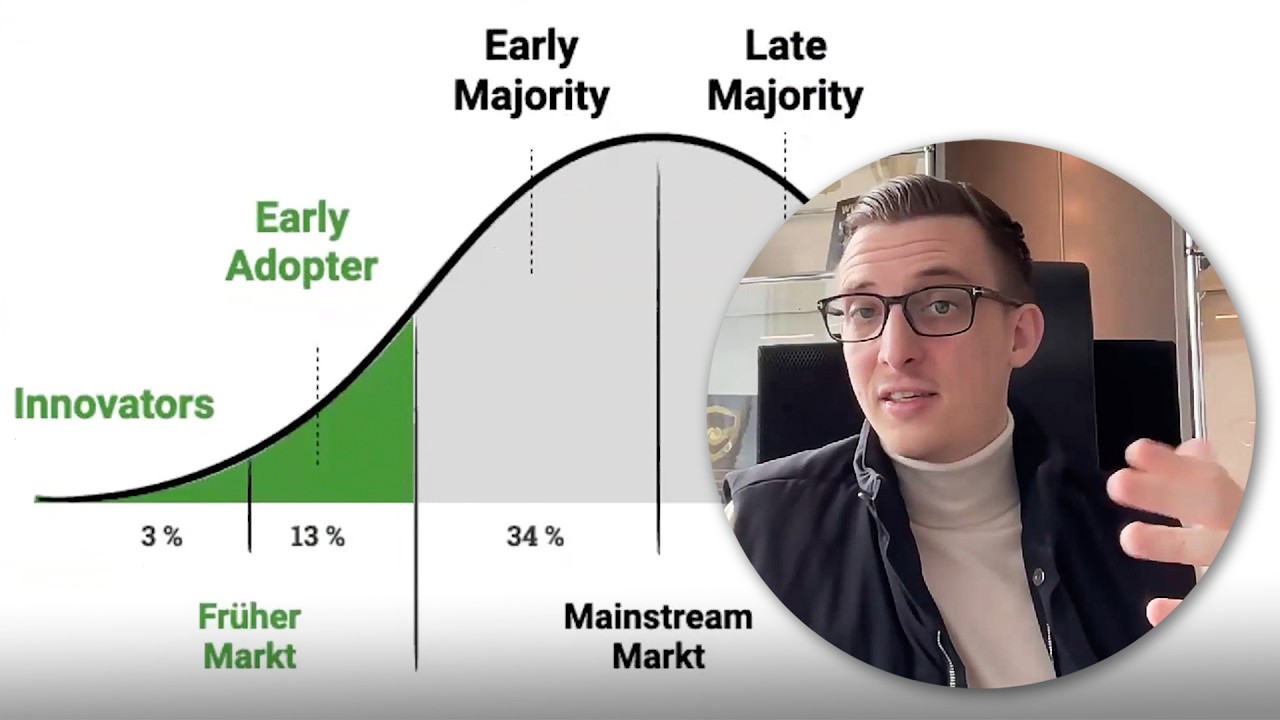
Instead, one should learn marketing and sales and maintain one's product range . Um, you have to consider that there are always ideas that have their own life cycles, right? There is this model with early adopters. Wait a minute , let me look it up. So, [snorting] there's this model here that shows, in essence, that at the beginning there are early adopters, then an early majority, a late majority, and then the Lagards, who come at the very end, who are simply the boomers who don't implement anything at all, like that. Or Innovate is even further ahead, starting so far ahead with this kind of stuff, where in principle nothing great can ultimately be done with it. And um, many self-employed people have their first big break, their breakthrough, because they offer something at the right time, in this first green phase, that is new, sexy, and more or less unknown. And that's why it has an inherent basic interest. At the same time, the curve is rising, with more and more people wanting to watch it. That means you only get positioned just in time to catch such a wave, and then the wave comes and carries you. The problem here, however, is that this graphic does not reflect this, because it only shows interest or how quickly people adopt the new thing. What is not reflected in the graphic here is when money is earned. And the perverse thing is that the money is earned in the late stages and not in the early stages. Um, can you imagine it something like, uh, I'm someone who's an innovator, I'm an early adopter of Facebook Ads personally? Okay, but when I started running Facebook Ads , the graphic is gone now, we do n't need it anymore. When I started running Metaads for myself as a consultant, so as a B2B offer more or less in 2016/17, I ended up paying around €40 to €50 for a consultation after a webinar. That means you had options like €3 or €4 on the webinar, an automated webinar, then they were in it, then about 65% came, then they watched it, then only 15 to 20 % applied after the initial consultation, so you had initial consultations with a pre- framed webinar, leads for €50 to €100 in some cases . It's super cheap in retrospect , isn't it? 100€ was already a lot, so we agreed on that price because we thought it was so expensive and it sounded really cool and was also nice. The problem is that at that time, 16 to 17, no one needed, thought about, or required online marketing. So, if you 're cheap because nobody's doing it yet, or someone's looking at it for the first time, or dealing with it for the first time, then nobody understands how to make real money, or there's no "it's nice to have to try it out" situation, but it hasn't become essential for survival. This means that in this early phase you have a few solo entrepreneurs who are doing something totally innovative, they find some people with it and so on, but they are really fighting against windmills because nobody actually wants that at that time. Later, when everyone wants and needs it, the prices for what you can sell will be much, much higher. So, if you used to be a Facebook Ads agency and you got around €1000 a month in retainers, you were super cool, but today that 's nothing. Today you'd have to be a multimillionaire with an agency because the demand is so high and the value of ads is so high, and so on and so forth. Just like now, when something is being sold using AI, for example, they do n't even get it, they do n't understand what it means. Not even you understand the implications of AI, and I probably don't either. So you understand? So, you're early to the market with something, it's relatively easy because there's little competition, but there's also little need and demand. However, later on, when it's a Red Ocean, so to speak (red always means there's a lot of blood in the water because so many sharks are swimming there), then they really start making money in it. That means sticking with it when things get tougher and there's competition, and people don't immediately say yes, is it a more worthwhile long-term game versus all the independent ones who can only, um, market something new for the first two years while it's new and who are essentially only sustained by taking orders? There is also a more severe version of this. This is the option where you can only sell with subsidies , where you not only have something new, but where the state also pays for it. That option is also available . Corona test centers, uh, heat pumps, PV systems, whatever there ever was in the past that was somehow subsidized, electric cars certainly at some point . So you understand, there's always a phase, which also includes subsidized businesses, that collapses every 5 years because the subsidies are cut and now consulting is subsidized in the digital sector. So these things still exist, and you always have to check that the money is in them . It's a long-term thing to do, because it's getting harder and harder and less and less sexy. So, currently, people aren't starting agencies in the SMMA field or similar areas anymore because it's no longer considered sexy or cool. People are thinking, "Do I still have a chance? There are already so many people in this niche. Is it still worth it?" I get that question 17 times a day in Q&A sessions, and I do n't even answer them every day. But it only becomes worthwhile later on, when the masses need it. It would be like you saying, "Yeah, you ca n't make money with computer people anymore because nobody can anymore, because there's already so much competition." And yet you still order a new laptop every three years.